
Calculadora do gradiente alvéolo-arterial
Calcule o gradiente alvéolo-arterial de oxigénio a partir de uma gasometria arterial, com o valor normal esperado para a idade, relação PaO2/FiO2, SpO2/FiO2 e índice ROX.
Como usar esta calculadora
- Retire a PaO₂ e a PaCO₂ diretamente da gasometria arterial, em mmHg.
- Introduza a FiO₂ que o doente respirava: 21% se era ar ambiente, ou a fração administrada se estava com oxigénio.
- Introduza a idade: o gradiente normal alarga com os anos, por isso um doente de 80 não se compara com um de 20.
- Ajuste a pressão barométrica se estiver acima do nível do mar. Isto importa: a 2.240 m, a mesma PaO₂ que pareceria anormal ao nível do mar pode ser o esperado.
- Leia primeiro o mecanismo e só depois o número. O sentido do gradiente é dizer-lhe se o problema está no pulmão.
FAQ
What is the alveolar-arterial gradient?
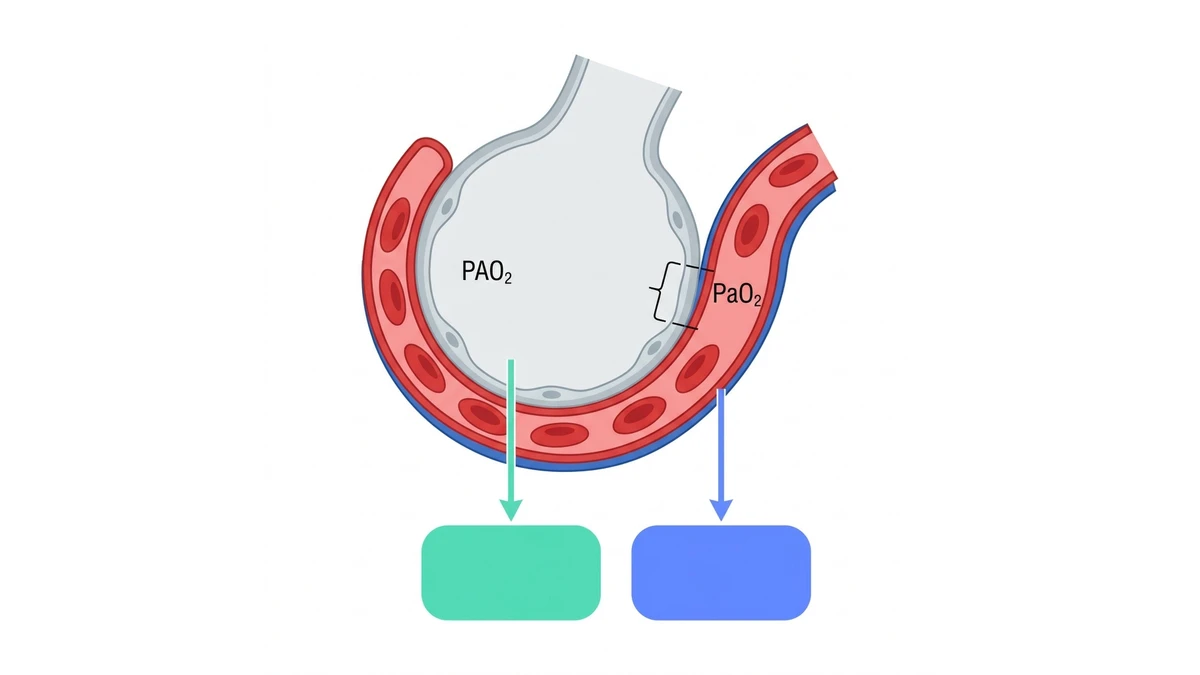
It is the difference between the oxygen tension in the alveolus (PAO₂, from the alveolar gas equation) and the one measured in arterial blood (PaO₂). It quantifies how much oxygen is lost crossing from air into blood.
What is a normal gradient for age?
The most widely used estimate is (age + 10) divided by 4 — about 10 mmHg at 30 years and about 20 mmHg at 70. That is why the gradient is always read with the age in front of it.
Why does the gradient separate the causes of hypoxaemia?
If someone is breathing too little, or the inspired air is oxygen-poor at altitude, alveolus and artery fall together and the gap between them stays normal. If the lung itself is the problem, oxygen does not cross properly and the gap widens.
Why adjust the barometric pressure?
The alveolar gas equation is pressure-dependent. At altitude there is less pressure and PAO₂ is physiologically lower. Leaving 760 mmHg when the blood gas was drawn in Mexico City or Bogotá invents a gradient that is not there.
CalcVita. (2026). Calculadora do gradiente alvéolo-arterial. CalcVita. Retrieved 8 de setembro de 2026, from https://calcvita.com/pt/calculadoras/gradiente-alveolo-arterial

Artigo recomendado
O gradiente A-a: ler a oxigenação para além do número do oxigénio
Porque é que um valor de oxigénio normal pode continuar a esconder um problema pulmonar, como a equação do gás alveolar separa o pulmão de tudo o resto, e porque é que o gradiente esperado sobe com a idade.
Ler o artigo completo →Mais calculadoras
Continue explorando ferramentas úteis
TFGe — Função renal
TFGe e estágio DRC com a fórmula CKD-EPI 2021 (KDIGO 2024).
Depuração de creatinina
Estime o CrCl com a equação Cockcroft-Gault para ajuste de fármacos.
Cálcio corrigido
Corrija o cálcio sérico pela albumina com a fórmula de Payne (1973).
Pressão arterial
Classifique sua pressão arterial pelas diretrizes AHA 2017.