
Calcolatore del gradiente alveolo-arterioso
Calcola il gradiente alveolo-arterioso di ossigeno da un’emogasanalisi arteriosa, con il valore normale atteso per età, rapporto PaO2/FiO2, SpO2/FiO2 e indice ROX.
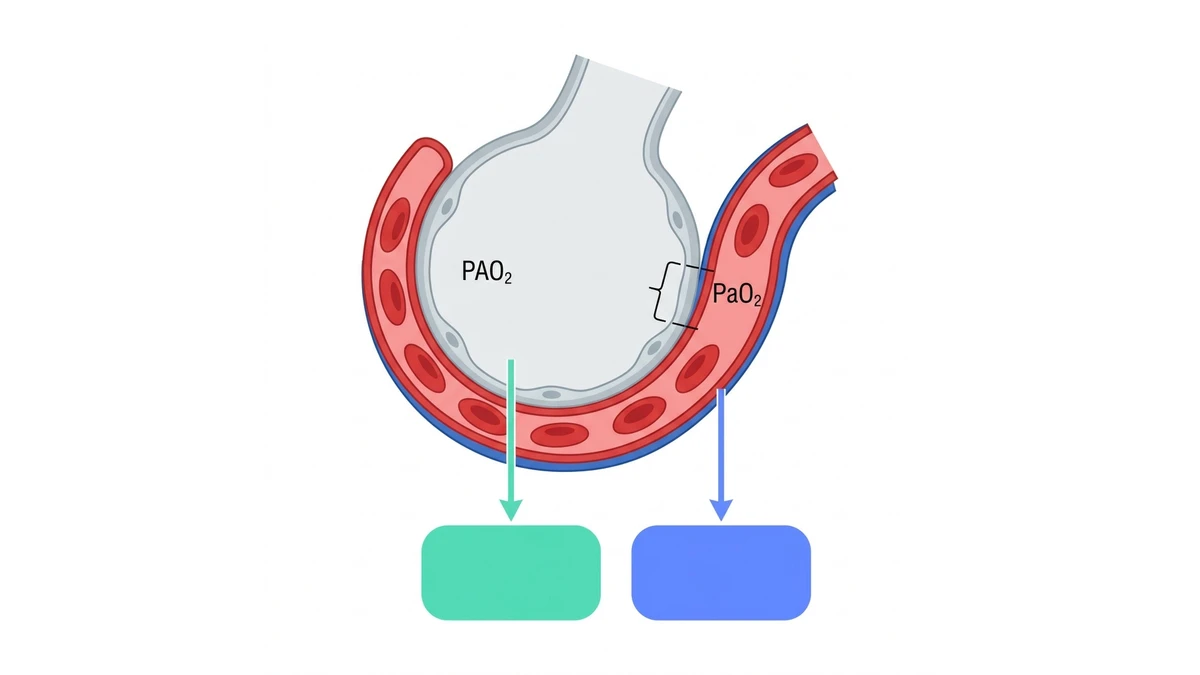
Come usare questo calcolatore
- Prendi PaO₂ e PaCO₂ direttamente dall’emogasanalisi arteriosa, in mmHg.
- Inserisci la FiO₂ che il paziente respirava: 21% in aria ambiente, o la frazione erogata se era in ossigeno.
- Inserisci l’età: il gradiente normale si allarga con gli anni, quindi un paziente di 80 anni non si confronta con uno di 20.
- Regola la pressione barometrica se sei sopra il livello del mare. Conta: a 2.240 m la stessa PaO₂ che sembrerebbe anomala al livello del mare può essere del tutto attesa.
- Leggi prima il meccanismo e poi il numero. Il senso del gradiente è dirti se il problema è nel polmone.
FAQ
What is the alveolar-arterial gradient?
It is the difference between the oxygen tension in the alveolus (PAO₂, from the alveolar gas equation) and the one measured in arterial blood (PaO₂). It quantifies how much oxygen is lost crossing from air into blood.
What is a normal gradient for age?
The most widely used estimate is (age + 10) divided by 4 — about 10 mmHg at 30 years and about 20 mmHg at 70. That is why the gradient is always read with the age in front of it.
Why does the gradient separate the causes of hypoxaemia?
If someone is breathing too little, or the inspired air is oxygen-poor at altitude, alveolus and artery fall together and the gap between them stays normal. If the lung itself is the problem, oxygen does not cross properly and the gap widens.
Why adjust the barometric pressure?
The alveolar gas equation is pressure-dependent. At altitude there is less pressure and PAO₂ is physiologically lower. Leaving 760 mmHg when the blood gas was drawn in Mexico City or Bogotá invents a gradient that is not there.
CalcVita. (2026). Calcolatore del gradiente alveolo-arterioso. CalcVita. Retrieved 8 settembre 2026, from https://calcvita.com/it/calcolatori/gradiente-alveolo-arterioso

Articolo consigliato
Il gradiente A-a: leggere l'ossigenazione oltre il numero dell'ossigeno
Perché un valore di ossigeno normale può comunque nascondere un problema polmonare, come l'equazione del gas alveolare separa il polmone da tutto il resto, e perché il gradiente atteso aumenta con l'età.
Leggi l'articolo completo →Altri calcolatori
Continua a esplorare strumenti utili
eGFR — Funzione renale
eGFR e stadio MRC con la formula CKD-EPI 2021 (KDIGO 2024).
Clearance creatinina
Stima la CrCl con la formula Cockcroft-Gault per il dosaggio dei farmaci.
Calcio corretto
Correggi il calcio sierico per l'albumina con la formula Payne (1973).
Pressione arteriosa
Classifica la pressione arteriosa secondo le linee guida AHA 2017.