
Rechner für die alveolo-arterielle Sauerstoffdifferenz
Berechnen Sie die alveolo-arterielle Sauerstoffdifferenz aus einer arteriellen Blutgasanalyse, mit dem altersabhängigen Normwert, PaO2/FiO2, SpO2/FiO2 und ROX-Index.
So verwenden Sie diesen Rechner
- Übernehmen Sie PaO₂ und PaCO₂ direkt aus der arteriellen Blutgasanalyse, in mmHg.
- Geben Sie die FiO₂ ein, die geatmet wurde: 21 % bei Raumluft oder den verabreichten Anteil unter Sauerstoff.
- Geben Sie das Alter ein: die normale Differenz wird mit den Jahren größer, ein 80-Jähriger wird nicht mit einem 20-Jährigen verglichen.
- Passen Sie den Luftdruck an, wenn Sie über Meereshöhe sind. Das zählt: auf 2 240 m kann dieselbe PaO₂, die auf Meereshöhe auffällig wäre, völlig erwartbar sein.
- Lesen Sie zuerst den Mechanismus, dann die Zahl. Der Sinn der Differenz ist zu sagen, ob die Lunge das Problem ist.
FAQ
What is the alveolar-arterial gradient?
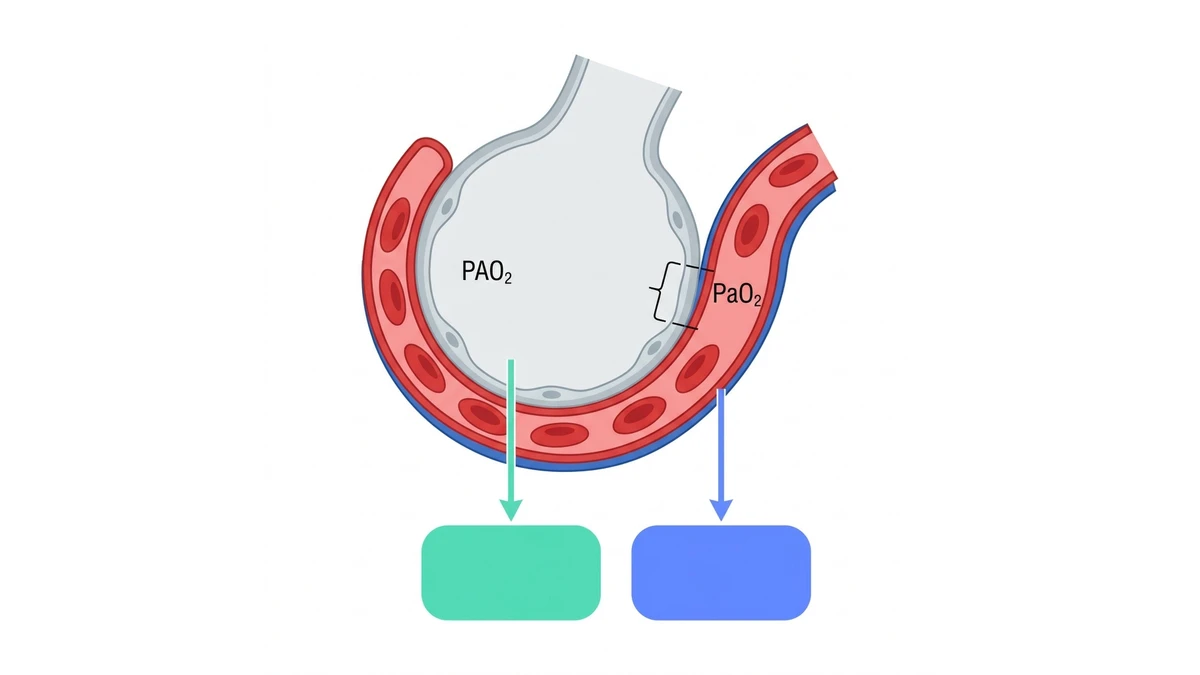
It is the difference between the oxygen tension in the alveolus (PAO₂, from the alveolar gas equation) and the one measured in arterial blood (PaO₂). It quantifies how much oxygen is lost crossing from air into blood.
What is a normal gradient for age?
The most widely used estimate is (age + 10) divided by 4 — about 10 mmHg at 30 years and about 20 mmHg at 70. That is why the gradient is always read with the age in front of it.
Why does the gradient separate the causes of hypoxaemia?
If someone is breathing too little, or the inspired air is oxygen-poor at altitude, alveolus and artery fall together and the gap between them stays normal. If the lung itself is the problem, oxygen does not cross properly and the gap widens.
Why adjust the barometric pressure?
The alveolar gas equation is pressure-dependent. At altitude there is less pressure and PAO₂ is physiologically lower. Leaving 760 mmHg when the blood gas was drawn in Mexico City or Bogotá invents a gradient that is not there.
CalcVita. (2026). Rechner für die alveolo-arterielle Sauerstoffdifferenz. CalcVita. Retrieved 8. September 2026, from https://calcvita.com/de/rechner/alveolo-arterielle-differenz

Empfohlener Artikel
Die alveolo-arterielle Differenz: Oxygenierung jenseits des Sauerstoffwerts lesen
Warum ein normaler Sauerstoffwert dennoch ein Lungenproblem verbergen kann, wie die Alveolargasgleichung die Lunge von allem anderen trennt, und warum die erwartete Differenz mit dem Alter steigt.
Den vollständigen Artikel lesen →Weitere Rechner
Entdecken Sie weitere nützliche Tools
eGFR — Nierenfunktion
eGFR und CKD-Stadium mit der CKD-EPI 2021 Formel (KDIGO 2024).
Kreatinin-Clearance
Schätzen Sie die CrCl mit der Cockcroft-Gault-Formel zur Dosisanpassung.
Korrigiertes Kalzium
Korrigieren Sie das Serumkalzium anhand des Albumins (Payne-Formel, 1973).
Blutdruck
Klassifizieren Sie Ihren Blutdruck nach AHA 2017-Leitlinien.