
Calculateur du gradient alvéolo-artériel
Calculez le gradient alvéolo-artériel en oxygène à partir d’une gazométrie artérielle, avec la valeur normale attendue selon l’âge, le rapport PaO2/FiO2, la SpO2/FiO2 et l’indice ROX.
Comment utiliser cette calculatrice
- Prenez la PaO₂ et la PaCO₂ directement sur la gazométrie artérielle, en mmHg.
- Saisissez la FiO₂ que respirait le patient : 21 % en air ambiant, ou la fraction délivrée sous oxygène.
- Saisissez l’âge : le gradient normal s’élargit avec les années, un patient de 80 ans ne se compare pas à un de 20 ans.
- Ajustez la pression barométrique si vous êtes au-dessus du niveau de la mer. C’est important : à 2 240 m, la même PaO₂ qui semblerait anormale au niveau de la mer peut être tout à fait attendue.
- Lisez d’abord le mécanisme, ensuite le chiffre. Le gradient sert à vous dire si le problème vient du poumon.
FAQ
What is the alveolar-arterial gradient?
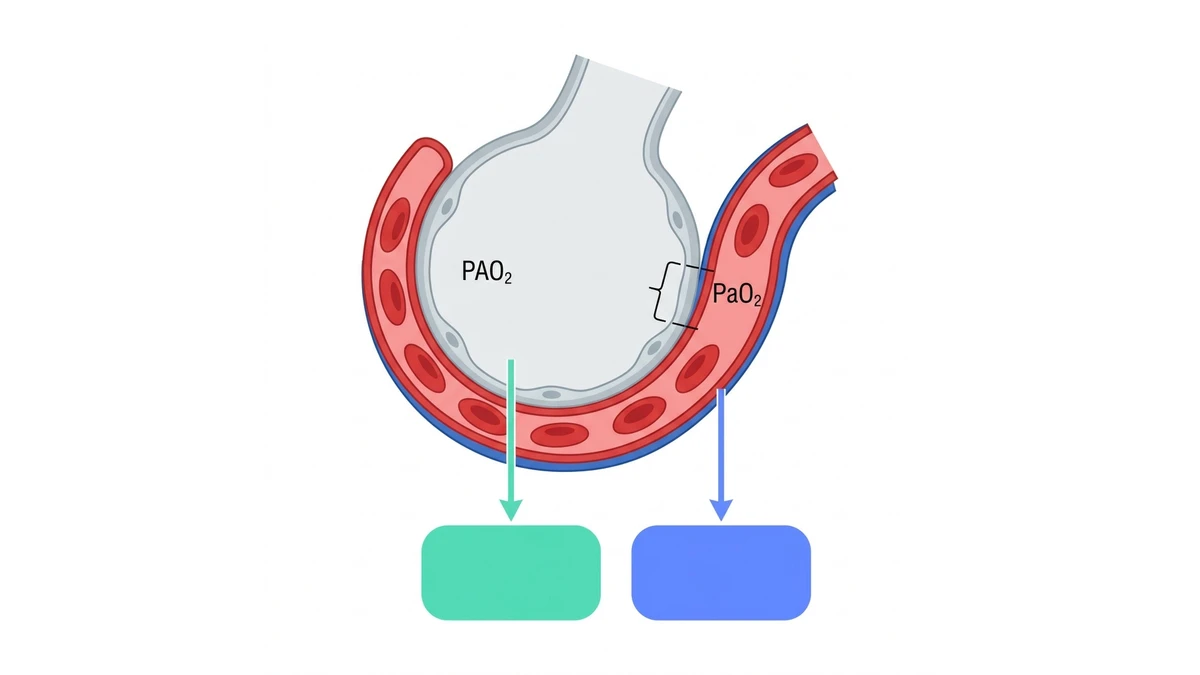
It is the difference between the oxygen tension in the alveolus (PAO₂, from the alveolar gas equation) and the one measured in arterial blood (PaO₂). It quantifies how much oxygen is lost crossing from air into blood.
What is a normal gradient for age?
The most widely used estimate is (age + 10) divided by 4 — about 10 mmHg at 30 years and about 20 mmHg at 70. That is why the gradient is always read with the age in front of it.
Why does the gradient separate the causes of hypoxaemia?
If someone is breathing too little, or the inspired air is oxygen-poor at altitude, alveolus and artery fall together and the gap between them stays normal. If the lung itself is the problem, oxygen does not cross properly and the gap widens.
Why adjust the barometric pressure?
The alveolar gas equation is pressure-dependent. At altitude there is less pressure and PAO₂ is physiologically lower. Leaving 760 mmHg when the blood gas was drawn in Mexico City or Bogotá invents a gradient that is not there.
CalcVita. (2026). Calculateur du gradient alvéolo-artériel. CalcVita. Retrieved 8 septembre 2026, from https://calcvita.com/fr/calculatrices/gradient-alveolo-arteriel

Article recommandé
Le gradient A-a : lire l'oxygénation au-delà du chiffre d'oxygène
Pourquoi une oxygénation normale peut malgré tout masquer un problème pulmonaire, comment l'équation des gaz alvéolaires sépare le poumon du reste, et pourquoi le gradient attendu augmente avec l'âge.
Lire l'article complet →Plus de calculateurs
Continuez à explorer des outils utiles
DFGe — Fonction rénale
DFGe et stade MRC avec la formule CKD-EPI 2021 (KDIGO 2024).
Clairance créatinine
Estimez la CrCl avec la formule Cockcroft-Gault pour ajuster les doses.
Calcium corrigé
Corrigez le calcium sérique en fonction de l'albumine (formule Payne, 1973).
Tension artérielle
Classifiez votre tension artérielle selon les recommandations AHA 2017.