
Kalkulator gradientu pęcherzykowo-tętniczego
Oblicz gradient pęcherzykowo-tętniczy tlenu z gazometrii tętniczej, wraz z wartością prawidłową dla wieku, wskaźnikiem PaO2/FiO2, SpO2/FiO2 i indeksem ROX.
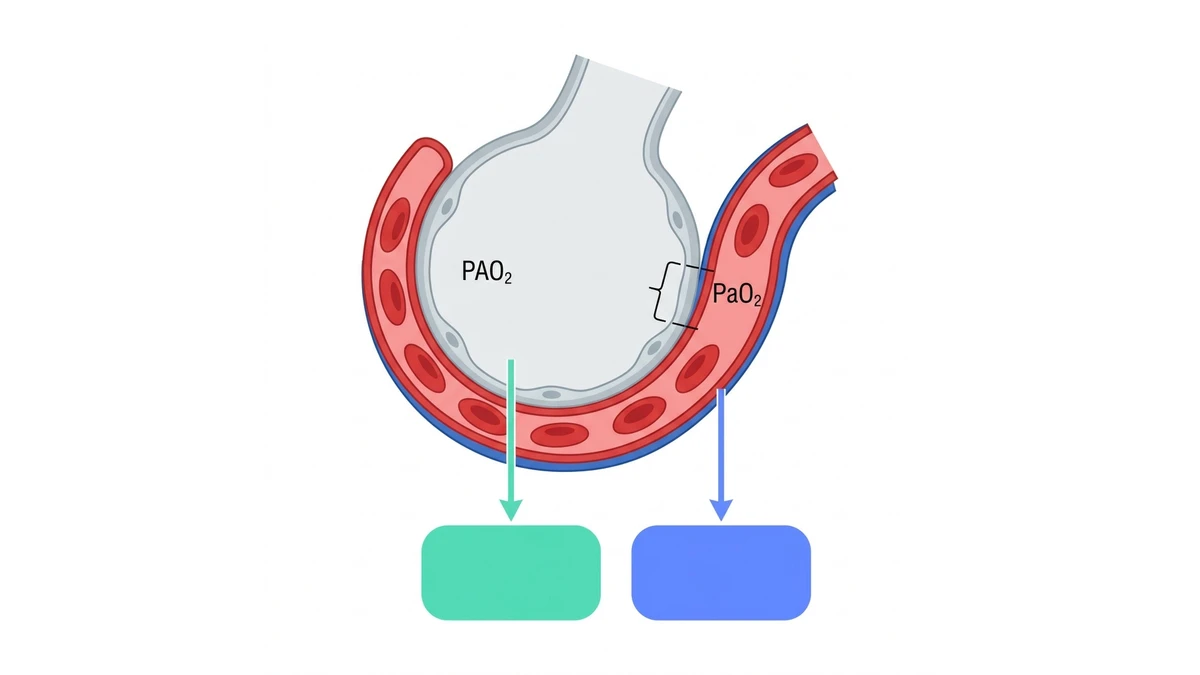
Jak korzystać z tego kalkulatora
- Weź PaO₂ i PaCO₂ wprost z gazometrii tętniczej, w mmHg.
- Wpisz FiO₂, którym pacjent oddychał: 21% przy powietrzu atmosferycznym lub podawaną frakcję przy tlenoterapii.
- Wpisz wiek: prawidłowy gradient poszerza się z latami, więc 80-latka nie porównuje się z 20-latkiem.
- Skoryguj ciśnienie barometryczne, jeśli jesteś powyżej poziomu morza. To ma znaczenie: na 2240 m ta sama PaO₂, która na poziomie morza wyglądałaby nieprawidłowo, może być całkiem oczekiwana.
- Czytaj najpierw mechanizm, potem liczbę. Sens gradientu polega na tym, by powiedzieć, czy problem jest w płucu.
FAQ
What is the alveolar-arterial gradient?
It is the difference between the oxygen tension in the alveolus (PAO₂, from the alveolar gas equation) and the one measured in arterial blood (PaO₂). It quantifies how much oxygen is lost crossing from air into blood.
What is a normal gradient for age?
The most widely used estimate is (age + 10) divided by 4 — about 10 mmHg at 30 years and about 20 mmHg at 70. That is why the gradient is always read with the age in front of it.
Why does the gradient separate the causes of hypoxaemia?
If someone is breathing too little, or the inspired air is oxygen-poor at altitude, alveolus and artery fall together and the gap between them stays normal. If the lung itself is the problem, oxygen does not cross properly and the gap widens.
Why adjust the barometric pressure?
The alveolar gas equation is pressure-dependent. At altitude there is less pressure and PAO₂ is physiologically lower. Leaving 760 mmHg when the blood gas was drawn in Mexico City or Bogotá invents a gradient that is not there.
CalcVita. (2026). Kalkulator gradientu pęcherzykowo-tętniczego. CalcVita. Retrieved 8 września 2026, from https://calcvita.com/pl/kalkulatory/gradient-pecherzykowo-tetniczy
Polecany artykuł
Gradient pęcherzykowo-tętniczy: czytanie utlenowania poza samą wartością tlenu
Dlaczego prawidłowa wartość tlenu może nadal ukrywać problem płucny, jak równanie gazu pęcherzykowego oddziela płuco od wszystkiego innego i dlaczego oczekiwany gradient rośnie z wiekiem.
Przeczytaj cały artykuł →Więcej kalkulatorów
Odkrywaj przydatne narzędzia
eGFR — Funkcja nerek
eGFR i stadium PChN z formułą CKD-EPI 2021 (KDIGO 2024).
Klirens kreatyniny
Oszacuj CrCl równaniem Cockcroft-Gault do dawkowania leków.
Skorygowany wapń
Skoryguj wapń surowicy na podstawie albuminy formułą Payne (1973).
Ciśnienie krwi
Sklasyfikuj ciśnienie krwi według wytycznych AHA 2017.