
Enter the details to calculate the percentile.
Choose the measurement, sex, age (years and months), and current value to understand the position on the curve.
A child growth percentile shows what percentage of children of the same age and sex weigh or measure less than yours, based on WHO reference tables. The 50th percentile is the median; the 3rd–97th range is considered normal when growth is steady. This calculator uses the WHO 0–5 standards and the WHO 5–19 reference.
Check your child's weight, height & head circumference percentile on WHO growth charts. Instant results with graphs, ages 0-19. Free, no signup required.
Choose the measurement, sex, age (years and months), and current value to understand the position on the curve.
CalcVita. (2026). Child Growth Percentile Calculator — WHO (0–19). CalcVita. Retrieved September 28, 2026, from https://calcvita.com/en/calculators/child-percentiles
Suggested article
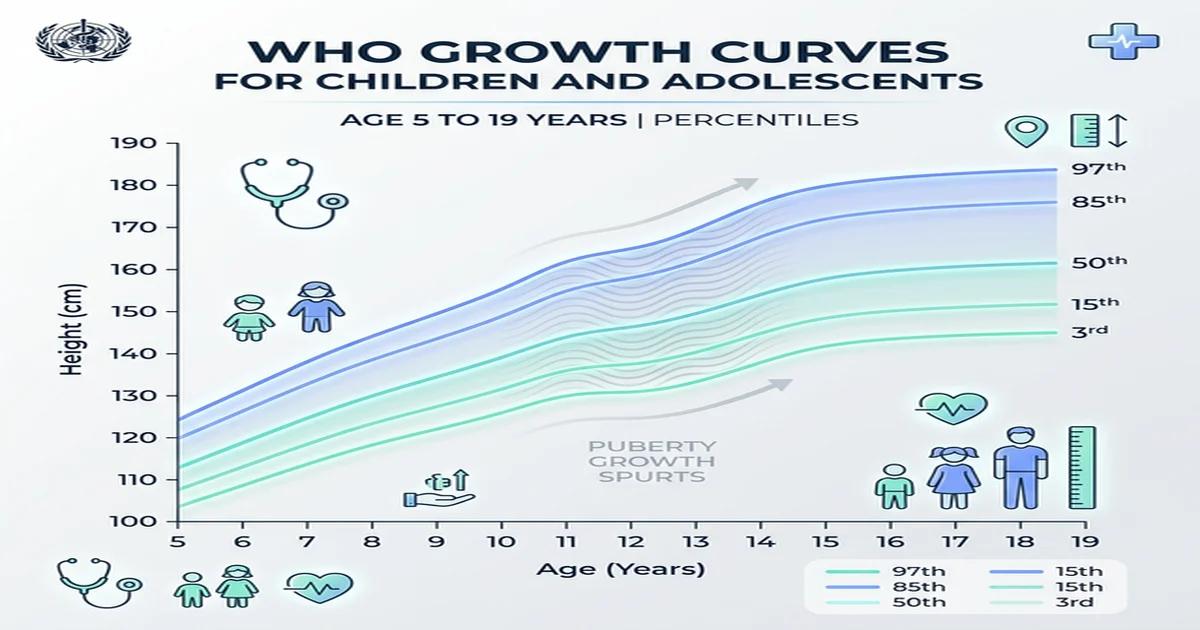
Learn how WHO and CDC growth charts work for school-age children and adolescents, what BMI-for-age percentiles mean during puberty, and when to consult a pediatrician.
Read the full article →Growth percentiles are a fundamental tool in pediatrics for assessing whether a child is developing appropriately. A percentile indicates what percentage of children of the same age and sex have a lower measurement. For example, if your child is at the 25th percentile for weight, it means 25% of children their age weigh less and 75% weigh more. The 50th percentile is the median: exactly half of the reference population falls above and the other half below. It is important to understand that a low percentile does not necessarily indicate a problem; what truly matters is the trend over time.
There are two main reference systems. The WHO (World Health Organization) charts cover ages 0 to 5 and are based on an international multicenter study of breastfed infants raised under optimal conditions; they represent how a healthy child should grow. The CDC (Centers for Disease Control and Prevention) charts cover ages 2 to 20 and are based on US population data; they describe how children actually grow in practice. The WHO recommends using its curves for children under 5 worldwide. Our calculator uses the WHO standards for ages 0-5 and the WHO reference tables for ages 5-19.
More important than the exact percentile number is that your child follows their own growth curve consistently. A child who stays around the 25th percentile is growing perfectly normally. Genetics, nutrition, and physical activity all influence where a child falls on the curve. Your pediatrician evaluates the trend across multiple check-ups, not a single measurement in isolation.
There are signs that warrant professional attention: if your child crosses two or more percentile lines upward or downward in a short period, if weight or height drops below the 3rd percentile or exceeds the 97th on a sustained basis, or if there is a sudden plateau in the growth curve. These changes do not always indicate a serious problem, but they should be evaluated by a healthcare professional to rule out nutritional, hormonal, or other causes.
Head circumference is routinely measured during the first two years of life and serves as an indirect indicator of brain growth. A head circumference within the normal percentiles suggests adequate brain development. A too-rapid increase may point toward elevated intracranial pressure, while slow growth could indicate microcephaly. As with weight and height, the most relevant factor is the trend over time, which your pediatrician will assess at each well-child visit.
We use the World Health Organization (WHO) standardized tables and formulas for children aged 0-5 and 5-19 years.
Head circumference percentiles in centimetres from the WHO Child Growth Standards (2006), computed from the same LMS tables the calculator uses. The 3rd to 97th percentile range is normal; what matters is that the child follows their own curve. To measure, run the tape just above the eyebrows and over the most prominent part of the back of the head.
| Age (months) | P3 | P15 | P50 | P85 | P97 |
|---|---|---|---|---|---|
| 0 | 32.1 | 33.1 | 34.5 | 35.8 | 36.9 |
| 3 | 38.3 | 39.3 | 40.5 | 41.7 | 42.7 |
| 6 | 41.0 | 42.1 | 43.3 | 44.6 | 45.6 |
| 9 | 42.6 | 43.7 | 45.0 | 46.3 | 47.4 |
| 12 | 43.6 | 44.7 | 46.1 | 47.4 | 48.5 |
| 18 | 44.9 | 46.0 | 47.4 | 48.7 | 49.9 |
| 24 | 45.7 | 46.8 | 48.3 | 49.7 | 50.8 |
| 30 | 46.3 | 47.5 | 48.9 | 50.4 | 51.6 |
| 36 | 46.8 | 48.0 | 49.5 | 50.9 | 52.1 |
| 42 | 47.2 | 48.4 | 49.9 | 51.4 | 52.6 |
| 48 | 47.5 | 48.7 | 50.2 | 51.7 | 53.0 |
| 54 | 47.7 | 49.0 | 50.5 | 52.0 | 53.3 |
| 60 | 47.9 | 49.2 | 50.7 | 52.3 | 53.5 |
| Age (months) | P3 | P15 | P50 | P85 | P97 |
|---|---|---|---|---|---|
| 0 | 31.7 | 32.7 | 33.9 | 35.1 | 36.1 |
| 3 | 37.2 | 38.2 | 39.5 | 40.8 | 41.9 |
| 6 | 39.7 | 40.8 | 42.2 | 43.5 | 44.6 |
| 9 | 41.3 | 42.4 | 43.8 | 45.2 | 46.3 |
| 12 | 42.3 | 43.5 | 44.9 | 46.3 | 47.5 |
| 18 | 43.6 | 44.8 | 46.2 | 47.7 | 48.8 |
| 24 | 44.6 | 45.7 | 47.2 | 48.6 | 49.8 |
| 30 | 45.3 | 46.5 | 47.9 | 49.4 | 50.6 |
| 36 | 45.9 | 47.0 | 48.5 | 50.0 | 51.2 |
| 42 | 46.3 | 47.5 | 49.0 | 50.4 | 51.6 |
| 48 | 46.7 | 47.9 | 49.3 | 50.8 | 52.0 |
| 54 | 47.0 | 48.2 | 49.6 | 51.1 | 52.3 |
| 60 | 47.2 | 48.4 | 49.9 | 51.4 | 52.6 |
The WHO publishes head circumference up to 5 years (60 months). Enter the measurement in the calculator to get the exact percentile at your child’s age.
More calculators
Weight percentile
Specialized weight calculator for babies and children (WHO).
Height predictor
Predict adult height using the Khamis-Roche method.
Child ADHD Screening (Vanderbilt)
Guidance screening with the Vanderbilt scale — not a diagnosis.
BMI calculator
Compute your BMI with WHO ranges and guidance.