
Khamis-Roche Height Prediction Calculator — Adult Height (±5 cm)
This calculator estimates a child's adult height from their age, sex, weight, current height and the parents' heights, using the Khamis-Roche method. It is a statistical prediction with a margin of about ±5 cm — not a diagnosis. The strongest single factor in final height is the parents' genetics.
Free child height predictor by age using the Khamis-Roche method (±5 cm). Enter age, weight and parent heights — no X-ray needed.
Estimation method
Child Stats
Parent Stats
CalcVita. (2026). Khamis-Roche Height Prediction Calculator — Adult Height (±5 cm). CalcVita. Retrieved September 28, 2026, from https://calcvita.com/en/calculators/child-height-predictor
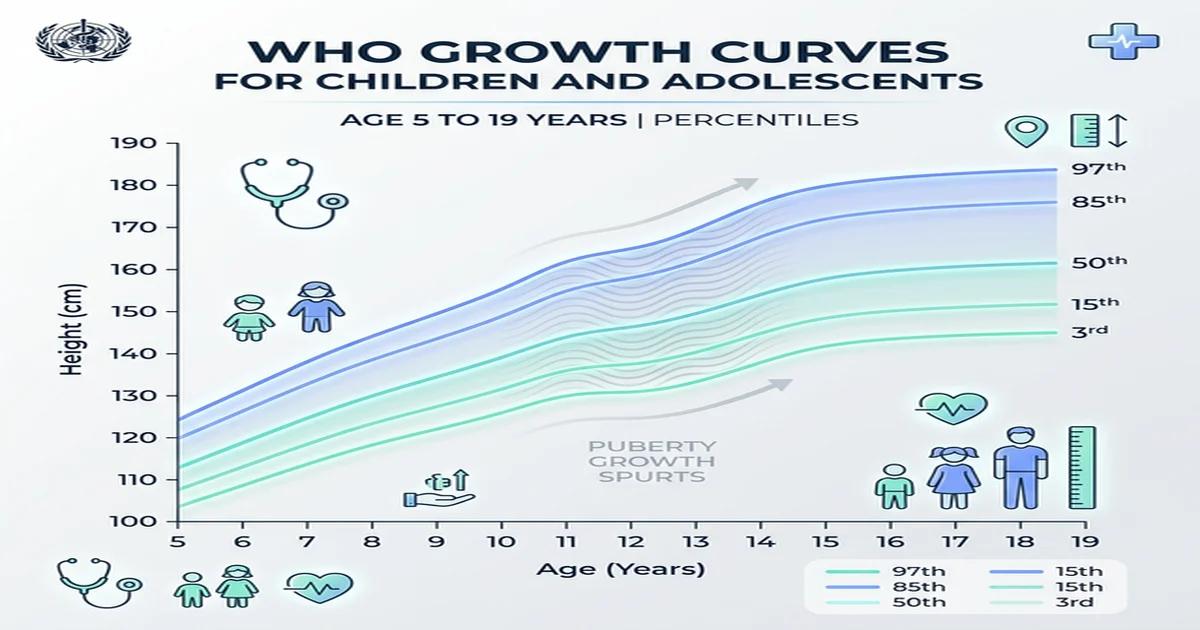
Suggested article
WHO Growth Percentiles for Children Aged 5-19: The Complete Guide
Learn how WHO and CDC growth charts work for school-age children and adolescents, what BMI-for-age percentiles mean during puberty, and when to consult a pediatrician.
Read the full article →Recommended reading
Key takeaways
- The Khamis-Roche method predicts adult height without a bone X-ray.
- It combines age, sex, weight, current height and mid-parental height.
- The typical margin of error is about ±5 cm.
- It is an indicative estimate, not a medical diagnosis.
How to use this child height predictor by age (Khamis-Roche)
This child height predictor uses the Khamis-Roche method — the gold standard for non-invasive adult height prediction. Unlike bone-age X-rays, it requires only the child's current age, height, weight, and both parents' heights, making it ideal for home use and routine paediatric check-ups. The calculator automatically selects the correct age-specific Khamis-Roche coefficient set, so results are calibrated for each stage of childhood development.
How it works
The method uses the child's current height, weight, age, and both parents' heights. It applies sex-specific regression coefficients derived from the Fels Longitudinal Study — a 70-year research project tracking growth in thousands of individuals. For children over 4 years of age, accuracy is typically within 5 cm (2 inches) of actual adult height.
Form fields
- Date of birth: enter the child's date of birth so the calculator can determine their exact decimal age.
- Sex: select male or female. The method uses different regression coefficients for each sex.
- Current height: enter the child's current standing height in centimetres (or feet/inches in imperial mode).
- Current weight: enter the child's current weight in kilograms (or pounds in imperial mode).
- Father's height: enter the biological father's adult height. If unknown, use the best available estimate.
- Mother's height: enter the biological mother's adult height. If unknown, use the best available estimate.
Interpreting results
The predicted adult height is the most likely final stature based on current growth data. The genetic potential (mid-parental height) shows the expected range based solely on parental heights, with a margin of approximately 8.5 cm above and below the mid-point. The confidence range reflects the statistical accuracy of the Khamis-Roche model for the child’s age and sex.
Khamis-Roche coefficients by age and sex
The Khamis-Roche method uses a set of sex-specific regression coefficients that vary by age group (from 4 to 17 years). Each coefficient set weights the child’s current height, weight, and both parents’ heights differently depending on how far along puberty the child is. Younger children rely more heavily on parental height as a predictor, while older children’s own height and weight carry more predictive weight. The calculator applies the correct coefficient set automatically based on the child’s decimal age, so you do not need to look up or enter any coefficients manually. The full coefficient table for boys and girls (ages 4 to 17.5 years, in half-year steps) is shown below for reference.
Formula (imperial units): predicted adult height (in) = B₀ + b₁·height(in) + b₂·weight(lb) + b₃·mid-parent(in), where mid-parent = (father + mother) ÷ 2. Values are the erratum-corrected coefficients (Khamis & Roche, Pediatrics 1994;94:504–507; erratum 1995;95:457).
Boys (males)
| Age (years) | Intercept (B₀) | Height (b₁) | Weight (b₂) | Mid-parent (b₃) |
|---|---|---|---|---|
| 4.0 | -10.2567 | 1.23812 | -0.087235 | 0.50286 |
| 4.5 | -10.719 | 1.15964 | -0.074454 | 0.52887 |
| 5.0 | -11.0213 | 1.10674 | -0.064778 | 0.53919 |
| 5.5 | -11.1556 | 1.0748 | -0.05776 | 0.53691 |
| 6.0 | -11.1138 | 1.05923 | -0.052947 | 0.52513 |
| 6.5 | -11.0221 | 1.05542 | -0.049892 | 0.50692 |
| 7.0 | -10.9984 | 1.05877 | -0.048144 | 0.48538 |
| 7.5 | -11.0214 | 1.06467 | -0.047256 | 0.46361 |
| 8.0 | -11.0696 | 1.06853 | -0.046778 | 0.44469 |
| 8.5 | -11.122 | 1.06572 | -0.046261 | 0.43171 |
| 9.0 | -11.1571 | 1.05166 | -0.045254 | 0.42776 |
| 9.5 | -11.1405 | 1.02174 | -0.043311 | 0.43593 |
| 10.0 | -11.038 | 0.97135 | -0.039981 | 0.45932 |
| 10.5 | -10.8286 | 0.89589 | -0.034814 | 0.50101 |
| 11.0 | -10.4917 | 0.81239 | -0.02905 | 0.54781 |
| 11.5 | -10.0065 | 0.74134 | -0.024167 | 0.58409 |
| 12.0 | -9.3522 | 0.68325 | -0.020076 | 0.60927 |
| 12.5 | -8.6055 | 0.63869 | -0.016681 | 0.62279 |
| 13.0 | -7.8632 | 0.60818 | -0.013895 | 0.62407 |
| 13.5 | -7.1348 | 0.59228 | -0.011624 | 0.61253 |
| 14.0 | -6.4299 | 0.59151 | -0.009776 | 0.58762 |
| 14.5 | -5.7578 | 0.60643 | -0.008261 | 0.54875 |
| 15.0 | -5.1282 | 0.63757 | -0.006988 | 0.49536 |
| 15.5 | -4.5092 | 0.68548 | -0.005863 | 0.42687 |
| 16.0 | -3.9292 | 0.75069 | -0.004795 | 0.34271 |
| 16.5 | -3.4873 | 0.83375 | -0.003695 | 0.24231 |
| 17.0 | -3.283 | 0.9352 | -0.00247 | 0.1251 |
| 17.5 | -3.4156 | 1.05558 | -0.001027 | -0.0095 |
Girls (females)
| Age (years) | Intercept (B₀) | Height (b₁) | Weight (b₂) | Mid-parent (b₃) |
|---|---|---|---|---|
| 4.0 | -8.1325 | 1.24768 | -0.19435 | 0.44774 |
| 4.5 | -6.47656 | 1.22177 | -0.18519 | 0.41381 |
| 5.0 | -5.13582 | 1.19932 | -0.1753 | 0.38467 |
| 5.5 | -4.13791 | 1.1788 | -0.16484 | 0.36039 |
| 6.0 | -3.51039 | 1.15866 | -0.154 | 0.34105 |
| 6.5 | -3.14322 | 1.13737 | -0.14294 | 0.32672 |
| 7.0 | -2.87645 | 1.11342 | -0.13184 | 0.31748 |
| 7.5 | -2.66291 | 1.08525 | -0.12086 | 0.3134 |
| 8.0 | -2.45559 | 1.05135 | -0.11019 | 0.31457 |
| 8.5 | -2.20728 | 1.01018 | -0.09999 | 0.32105 |
| 9.0 | -1.87098 | 0.9602 | -0.09044 | 0.33291 |
| 9.5 | -1.0633 | 0.89989 | -0.08171 | 0.35025 |
| 10.0 | 0.33468 | 0.82771 | -0.07397 | 0.37312 |
| 10.5 | 1.97366 | 0.74213 | -0.06739 | 0.40161 |
| 11.0 | 3.50436 | 0.67173 | -0.06136 | 0.42042 |
| 11.5 | 4.57747 | 0.6415 | -0.05518 | 0.41686 |
| 12.0 | 4.84365 | 0.64452 | -0.04894 | 0.3949 |
| 12.5 | 4.27869 | 0.67386 | -0.04272 | 0.3585 |
| 13.0 | 3.21417 | 0.7226 | -0.03661 | 0.31163 |
| 13.5 | 1.83456 | 0.78383 | -0.03067 | 0.25826 |
| 14.0 | 0.32425 | 0.85062 | -0.025 | 0.20235 |
| 14.5 | -1.13224 | 0.91605 | -0.01967 | 0.14787 |
| 15.0 | -2.35055 | 0.97319 | -0.01477 | 0.0988 |
| 15.5 | -3.10326 | 1.01514 | -0.01037 | 0.05909 |
| 16.0 | -3.17885 | 1.03496 | -0.00655 | 0.03272 |
| 16.5 | -2.41657 | 1.02573 | -0.0034 | 0.02364 |
| 17.0 | -0.65579 | 0.98054 | -0.001 | 0.03584 |
| 17.5 | 2.26429 | 0.89246 | 0.00057 | 0.07327 |
Limitations
The prediction is less accurate for children under 4 years of age because early growth is highly variable. It does not account for hormonal disorders (e.g. growth hormone deficiency, precocious puberty) or chronic illness. It assumes adequate nutrition and a healthy environment. For clinical purposes, a bone-age X-ray provides higher accuracy but requires medical imaging.
Practical tips
- Ensure the child receives balanced nutrition with sufficient protein, calcium, and vitamin D to support healthy growth.
- Adequate sleep is essential for growth hormone release, especially during deep-sleep phases at night.
- Repeat the measurement every 6–12 months to track the growth trajectory and compare against the predicted target.
Sources
- Khamis HJ, Roche AF. “Predicting adult stature without using skeletal age: the Khamis-Roche method.” Pediatrics. 1994;94(4):504-507.
- WHO Multicentre Growth Reference Study Group. WHO Child Growth Standards. Geneva: World Health Organization; 2006.
- Roche AF, Davila GH. “Late adolescent growth in stature.” Pediatrics. 1972;50(6):874-880.
Frequently asked questions
- How tall will my child be when they grow up?
- You can estimate your child's adult height using the Khamis-Roche method, which combines the child's current age, height, weight, and both parents' heights. The prediction is accurate to within ±5 cm (2 inches) for children aged 4 and older. Enter the measurements in our free child height predictor for an instant result.
- How accurate is this child height predictor by age?
- The Khamis-Roche method has a margin of error of about 5 cm (2 inches) for children over 4, and improves further after age 7. It is the most reliable non-invasive method available — more accurate than the traditional mid-parental height formula because it also factors in the child's current age and weight.
- What are the Khamis-Roche coefficients and how do they change by age?
- The Khamis-Roche method uses sex-specific regression coefficients that vary by age group, covering children from 4 to 17 years old. Each age-group coefficient set assigns a different weight to the child's current height, weight, and parental heights, reflecting how the relative importance of each factor shifts during puberty. This calculator applies the correct coefficient set automatically based on the child's decimal age — you do not need to look up or enter any values manually.
- What is mid-parental height (target height)?
- Mid-parental height (also called target height or genetic potential) estimates a child's expected adult height based on their parents' heights. Formula: for boys, add both parents' heights and 13 cm, then divide by 2; for girls, add both parents' heights and subtract 13 cm, then divide by 2. The result has a ±8.5 cm range.
- When do children stop growing?
- Girls typically stop growing 1–2 years after their first menstrual period, usually around age 14–16. Boys generally stop growing between ages 16 and 18, once they have completed puberty. Growth plates (epiphyseal plates) close at this point, making further height gain impossible.
- What is the Khamis-Roche method?
- The Khamis-Roche method is a scientifically validated technique for predicting a child's adult height without X-rays. It uses regression coefficients derived from the Fels Longitudinal Study — a 70-year research project — to combine the child's age, weight, height, and both parents' heights into an accurate adult height estimate.
More calculators
Keep exploring helpful tools
Child growth percentiles
Weight, height and head size vs. international charts.
Weight percentile
Specialized weight calculator for babies and children (WHO).
Child ADHD Screening (Vanderbilt)
Guidance screening with the Vanderbilt scale — not a diagnosis.
BMI calculator
Compute your BMI with WHO ranges and guidance.