Pediatric growth
WHO Growth Percentiles for Children Aged 5-19: The Complete Guide
Learn how WHO and CDC growth charts work for school-age children and adolescents, what BMI-for-age percentiles mean during puberty, and when to consult a pediatrician.
Free online tool
Child growth percentiles
Why the 5-19 age range needs its own growth charts
Growth monitoring does not stop at kindergarten. Between 5 and 19 years of age children undergo profound changes in body composition, hormonal activity, and skeletal maturation. The WHO Multicentre Growth Reference Study (MGRS) that covers birth to 5 years was designed as a prescriptive standard: it describes how healthy, breastfed children should grow under optimal conditions. From age 5 onward the WHO switched to a different methodology, releasing the 2007 Growth Reference for school-age children and adolescents, which is a descriptive reference built from historical datasets.
This distinction matters. The 0-5 standards tell you how a child ought to grow; the 5-19 references tell you how a representative sample actually grew. Pediatricians use these reference curves to track height-for-age, weight-for-age, and BMI-for-age, flagging any child whose trajectory deviates from expected patterns.
The WHO 2007 reference was constructed by re-analysing data from the 1977 National Center for Health Statistics (NCHS) dataset alongside data from the WHO Child Growth Standards cross-sectional sample. Researchers applied the Box-Cox power exponential method to produce smooth centile curves that merge seamlessly at age 5 with the existing 0-5 standards. This careful bridging means that a child monitored from birth can transition to the 5-19 reference without an artificial jump in percentile.
WHO vs CDC charts
The WHO 2007 reference covers ages 5-19 and is used in most countries worldwide. The CDC 2000 charts cover ages 2-20 and are primarily used in the United States. Both systems use percentiles, but their cutoffs differ slightly. The WHO reference is generally recommended for international comparisons.
How percentile charts work for school-age children
A percentile rank tells you where a child stands relative to a reference population of the same age and sex. If a 10-year-old girl is at the 75th percentile for height, she is taller than 75 out of 100 girls her age in the reference sample. Percentiles are not pass-or-fail grades; they describe position on a bell curve.
Plot your child's WHO percentile (5-19)
Enter your child's sex, date of birth, height and weight to get their exact height-for-age percentile on the WHO 5-19 reference (and weight-for-age up to age 10) — with an instant growth curve.
Open the WHO growth percentile calculator →Key indicators tracked from 5 to 19 years
- Height-for-age (HAZ): screens for stunting and tall stature.
- Weight-for-age (WAZ): available up to age 10 in the WHO reference; less useful after puberty onset because weight gains from muscle vs fat cannot be separated.
- BMI-for-age (BAZ): the primary indicator for nutritional status in school-age children and adolescents because it adjusts for the natural increase in body mass that accompanies growth in height.
- Weight-for-height: only used up to 5 years in the WHO system; after that, BMI-for-age takes over.
The WHO reference uses z-scores as the underlying metric. A z-score of 0 corresponds to the median (50th percentile). Clinicians typically flag values beyond -2 or +2 standard deviations for further evaluation.
WHO z-score classification for 5-19 years
Below -3 SD
Severe thinness / severe stunting
Urgent medical and nutritional assessment required.
-3 to -2 SD
Thinness / stunting
Moderate risk; needs dietary review and follow-up.
-2 to +1 SD
Normal range
Covers approximately the 2nd to 85th percentile.
+1 to +2 SD
Overweight (BMI-for-age)
Roughly the 85th to 97th percentile; lifestyle adjustment recommended.
Above +2 SD
Obesity (BMI-for-age)
Above the 97th percentile; medical evaluation advised.
BMI-for-age: the central tool after age 5
Unlike adult BMI, which uses fixed cutoffs (25 for overweight, 30 for obesity), pediatric BMI must be interpreted against age- and sex-specific reference values. A BMI of 21 may be perfectly normal for a 16-year-old boy but would signal excess weight in an 8-year-old girl. This is why raw BMI numbers are meaningless without the age context that percentile or z-score tables provide.
The WHO 2007 reference derives BMI-for-age curves from the same datasets used for height and weight, applying the same Box-Cox power exponential method; the curves are published as L, M and S values for each month of age. This produces smooth, continuous percentile lines from age 5 through 19 for both sexes.
How to interpret BMI-for-age results
- Calculate BMI: weight (kg) divided by height (m) squared.
- Plot the value on a sex-specific WHO BMI-for-age chart.
- Read the percentile or z-score from the curve.
- Compare the current reading with previous measurements to assess the trajectory over time.
- If the percentile crosses two or more major lines (e.g., from the 50th to the 85th) within 6-12 months, schedule a pediatric consultation.
Puberty, growth spurts, and what parents should expect
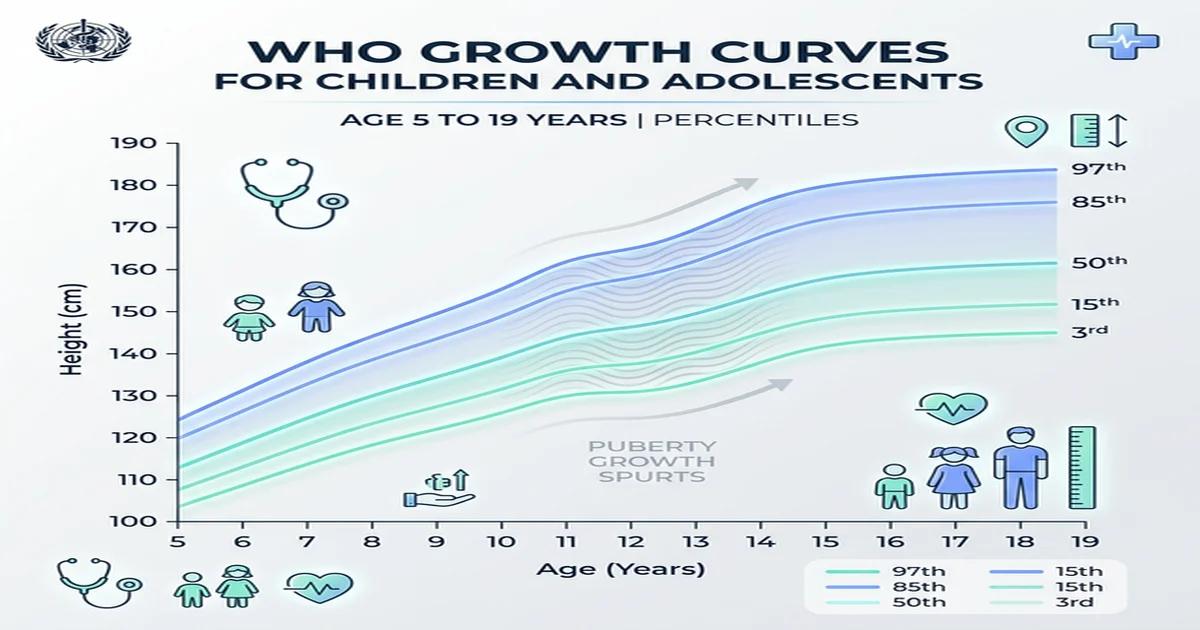
Puberty is the most dramatic growth phase after infancy. Girls typically enter puberty between ages 8 and 13, while boys start between 9 and 14. During the pubertal growth spurt, children can gain 8-12 cm per year at peak velocity, compared with the steady 5-6 cm per year of mid-childhood. Alongside height, weight increases rapidly as lean mass, bone density, and — in girls particularly — fat mass accumulate under hormonal influence.
This rapid growth creates natural fluctuations on percentile charts. A child who was at the 50th percentile for height at age 9 might jump to the 75th during the growth spurt, then return close to the 50th once growth slows. These temporary shifts are expected and do not necessarily indicate a problem, as long as the overall trajectory remains consistent.
Sex differences in growth timing
- Girls reach peak height velocity about 2 years earlier than boys (around age 11-12 vs 13-14).
- Girls gain more relative fat mass during puberty; boys gain more lean mass.
- Growth plates typically close by age 14-16 in girls and 16-18 in boys.
- A child who enters puberty early may appear tall initially but finish at an average or even shorter adult height because the growth plates close sooner.
Early and late bloomers
Constitutional growth delay (late blooming) is the most common cause of short stature in adolescents. These children eventually reach a normal adult height, but their growth spurt starts later. If a child shows no signs of puberty by age 13 (girls) or 14 (boys), a pediatric endocrinologist should evaluate whether the delay is constitutional or pathological.
Warning signs every parent should know
Most children follow a predictable percentile channel. The following red flags warrant a visit to the pediatrician.
Indicators of potential concern
- Height-for-age below the 3rd percentile (z-score below -2) on two consecutive visits: possible stunting or endocrine disorder.
- BMI-for-age above the 85th percentile: classified as overweight by WHO; above the 97th percentile signals obesity.
- Crossing two or more major percentile lines in either direction within 12 months.
- No signs of pubertal development by age 13 in girls or 14 in boys (delayed puberty).
- Very early puberty (before age 8 in girls or 9 in boys) with rapid acceleration on the growth chart.
- Significant discrepancy between height percentile and weight percentile (e.g., height at the 25th but weight at the 90th).
Globally, childhood obesity has risen sharply. The WHO estimates that 390 million children aged 5-19 were overweight in 2022, of whom 160 million were living with obesity. At the same time, 148 million children under 5 remained stunted and many school-age children in low-income settings still experience chronic undernutrition. Percentile monitoring helps catch both ends of the spectrum.
Using the calculator to track your child's growth
Our child growth percentile calculator implements the WHO 2007 reference data for ages 5-19 and the WHO Child Growth Standards for ages 0-5. Enter your child's date of birth, sex, current weight and height, and the tool returns the exact height-for-age percentile and, up to age 10 (where the WHO weight-for-age reference ends), the weight-for-age percentile. It does not calculate BMI-for-age: for that, use the WHO BMI-for-age charts.
- Open the child growth percentile calculator on CalcVita.
- Select your child's sex and enter the date of birth.
- Enter the most recent weight (kg or lbs) and height (cm or inches).
- Review the height-for-age percentile and, up to age 10, the weight-for-age percentile.
- Save the result or take a screenshot so you can compare it with future measurements.
Tracking growth over time is more valuable than any single measurement. We recommend measuring every 3-6 months during childhood and every 6 months during adolescence, always using a stadiometer or wall-mounted height ruler for accuracy.
Tips for accurate measurements at home
- Measure in the morning, when intervertebral discs are fully hydrated and height is at its maximum.
- Have the child stand barefoot with heels, buttocks, shoulder blades, and the back of the head touching the wall.
- Use a flat object (a book or ruler) pressed horizontally against the top of the head to mark the wall.
- Weigh in light clothing, ideally after using the bathroom and before eating breakfast.
Growth charts are powerful screening tools, but they are not diagnostic on their own. A child who falls outside the expected range deserves a thorough clinical assessment including dietary history, family growth patterns, and potentially laboratory tests. Conditions such as growth hormone deficiency, coeliac disease, hypothyroidism, or Turner syndrome can all manifest as unexpected percentile shifts. Early identification through regular monitoring can lead to timely intervention and better outcomes. Use our child growth percentile calculator as a first step, then share the results with your pediatrician to build a complete picture of your child's health.
Sources
- WHO Growth Reference 5-19 years
- de Onis M, et al. Development of a WHO growth reference for school-aged children and adolescents. Bull World Health Organ. 2007;85(9):660-667. doi:10.2471/BLT.07.043497
- WHO Fact Sheet: Obesity and Overweight (2024)
- CDC Growth Charts: United States
- Kuczmarski RJ, et al. 2000 CDC Growth Charts for the United States: methods and development. Vital Health Stat 11. 2002;(246):1-190.