Pediatric growth
WHO Growth Percentile Tables for Children 0-5: A Complete Parent's Guide
Learn how to read WHO growth percentile charts for weight, height and head circumference in children aged 0 to 5. Understand what the curves mean, when patterns are concerning and how our child growth percentile calculator can help you track your child's development.
Free online tool
Child growth percentiles
What are growth percentiles?
Growth percentiles compare your child's physical measurements against a reference population of healthy children of the same age and sex. If your baby is at the 40th percentile for weight, it means that 40 percent of healthy children of the same age and sex weigh the same or less, while 60 percent weigh more. Percentiles are not grades: a child at the 15th percentile is not necessarily healthier or less healthy than one at the 85th percentile.
Plot your child's growth percentile
Enter your child's sex, date of birth and measurements to see their exact weight-for-age, length/height-for-age and head-circumference percentiles on the official WHO charts — with an instant growth curve.
Open the WHO growth percentile calculator →The World Health Organization (WHO) published its Child Growth Standards in 2006 after the Multicentre Growth Reference Study (MGRS), which followed more than 8,400 breastfed children from six countries (Brazil, Ghana, India, Norway, Oman and the United States). Because the sample included children raised under optimal conditions, the WHO curves describe how children should grow, not merely how they do grow in a particular population.
WHO standards vs CDC charts
The WHO standards (2006) are recommended for children aged 0-2 years worldwide and for ages 0-5 in most countries. The CDC growth charts (2000) are based on a US sample that included formula-fed infants and are used primarily for children 2-20 years in the United States. Following an expert panel it convened in 2006 with the National Institutes of Health and the American Academy of Pediatrics, the CDC recommends that clinicians in the United States use the WHO charts for all children under 2 years of age.
How to read WHO growth charts
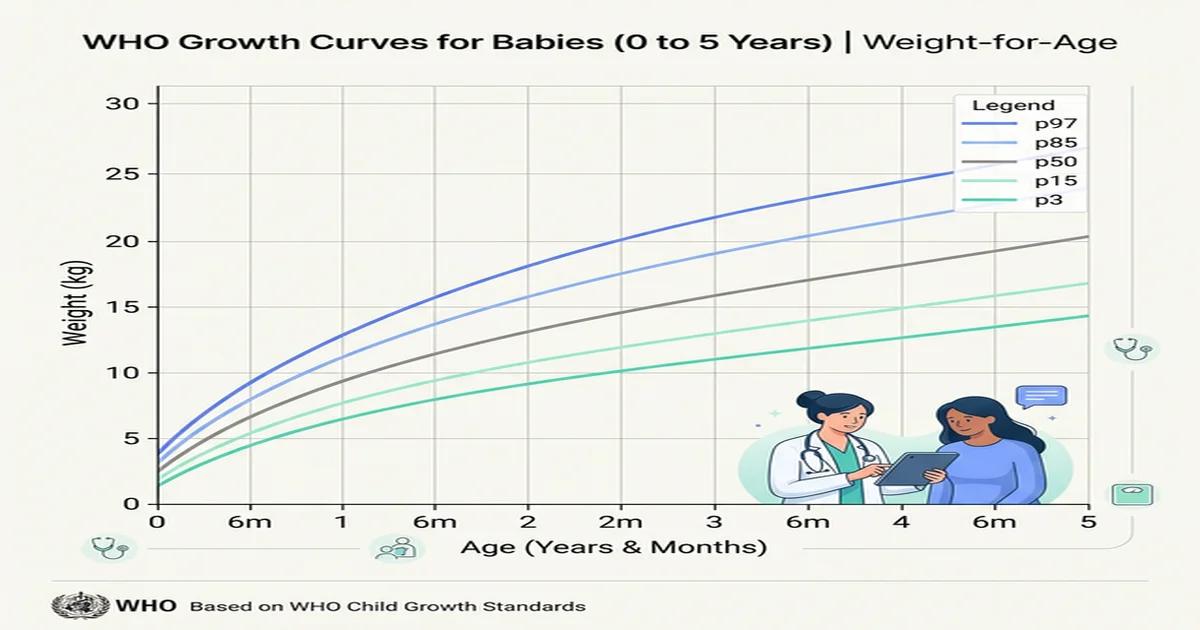
WHO growth charts plot age on the horizontal axis and the measurement (weight, length/height or head circumference) on the vertical axis. Curved lines represent selected percentiles, typically the 3rd, 15th, 50th, 85th and 97th. The space between these lines defines channels. A child's position on a single visit matters far less than the trajectory over multiple visits.
Weight-for-age
Weight-for-age is the most commonly tracked parameter during the first two years. Newborns typically lose 5-7 percent of birth weight in the first few days and regain it by day 10-14. After that initial period, a healthy infant roughly doubles birth weight by 4-5 months and triples it by 12 months. The WHO chart lets you verify that this trajectory stays within a consistent percentile channel.
Typical weight milestones (median, boys)
Birth
3.3 kg
WHO 50th percentile for boys at birth.
6 months
7.9 kg
Roughly 2.4 times birth weight.
12 months
9.6 kg
Approximately triple birth weight.
24 months
12.2 kg
Growth velocity starts to slow.
5 years
18.3 kg
Steady gain of about 2 kg per year from age 2.
Length/height-for-age
Until age 2, length is measured lying down (supine); after age 2, standing height is used. The WHO charts account for the roughly 0.7 cm difference between the two methods. Average birth length is about 49-50 cm, with infants gaining approximately 25 cm in the first year, 12-13 cm in the second year and about 6-8 cm per year thereafter until age 5.
Head circumference-for-age
Head circumference reflects brain growth and is routinely measured until age 2-3 years. The average newborn head circumference is about 34-35 cm, increasing by approximately 12 cm in the first year. Rapid crossing of percentile lines, either upward or downward, may warrant investigation for conditions such as hydrocephalus or microcephaly.
BMI-for-age
WHO provides BMI-for-age charts starting at birth. For children under 5, the WHO classifies a BMI-for-age (or weight-for-length) above +2 SD (about the 97.7th percentile) as overweight and above +3 SD as obesity; the 85th/97th-percentile cut-offs used for school-age children do not apply at this age. Unlike adult BMI thresholds, pediatric BMI must always be interpreted relative to age and sex.
Understanding z-scores and growth velocity
Alongside percentiles, pediatricians often use z-scores (also called standard deviation scores) to express how far a measurement is from the median. A z-score of 0 corresponds to the 50th percentile, while -2 and +2 roughly correspond to the 3rd and 97th percentiles, respectively. Z-scores are especially useful at the extremes of the distribution, where small changes in percentile correspond to large clinical differences.
Growth velocity refers to the rate of change in a measurement over time. A child may sit at the 10th percentile and be perfectly healthy if that has been their consistent channel. Conversely, a child at the 70th percentile who suddenly decelerates to the 30th over three months may need evaluation, even though the 30th percentile is well within the normal range. WHO provides velocity tables that complement the attained-growth charts and help clinicians identify deceleration or acceleration earlier.
Normal patterns vs concerning signals
The most important principle in pediatric growth monitoring is that the trend matters more than any single point. Children tend to follow a percentile channel. Healthy children may shift channels in the first 2-3 months as they settle into their genetic trajectory, but sustained crossing of two or more major percentile lines after that period deserves clinical attention.
- Normal: a child tracks between the 25th and 50th percentile over multiple visits.
- Normal: a newborn drops from the 75th to the 50th percentile in the first 2-3 months, then stabilizes.
- Concerning: weight drops from the 50th to below the 10th percentile over 3-6 months.
- Concerning: head circumference rises from the 50th to above the 97th percentile rapidly.
- Concerning: weight-for-length climbs from the 60th to above the 95th percentile without a corresponding height increase.
Faltering growth (previously called failure to thrive) is typically defined as weight falling below the 3rd percentile or crossing downward through two major percentile lines. It can result from inadequate intake, malabsorption, chronic illness or psychosocial factors. Early detection through regular growth monitoring is critical.
When to see a pediatrician
Routine well-child visits already include growth assessment, but there are specific situations where you should seek additional guidance sooner rather than later.
- Your child's weight, height or head circumference crosses two or more major percentile lines upward or downward.
- Weight-for-length or BMI-for-age consistently falls above the 97th or below the 3rd percentile.
- Your child loses weight or fails to gain weight over a period of more than 2-3 months.
- Head circumference grows much faster or slower than expected for the child's age.
- You notice feeding difficulties, chronic vomiting, diarrhea or refusal to eat.
- The child appears significantly smaller or larger than peers despite similar genetic background.
Premature babies need adjusted charts
If your child was born before 37 weeks of gestation, the pediatrician will use corrected age (chronological age minus weeks of prematurity) when plotting growth until at least 2 years of age. This adjustment prevents overdiagnosis of growth problems in preterm infants.
How our child growth percentile calculator helps
Our child growth percentile calculator uses the same WHO reference data described in this article. You enter your child's date of birth, sex, weight, length or height and, optionally, head circumference, and the tool instantly returns the exact percentile for each measurement. It also draws the WHO curves so you can see where your child falls.
- Uses official WHO Child Growth Standards (2006) for children aged 0-5 years.
- Calculates weight-for-age, length/height-for-age and head circumference percentiles.
- Draws the WHO 3rd, 15th, 50th, 85th and 97th percentile curves with your child's point on them.
- Free, private and requires no account or registration.
While the calculator is a powerful tracking tool, it does not replace professional medical advice. Use it to prepare for your next well-child visit by having your child's latest measurements ready and already interpreted against the WHO standards.
Nutrition and growth in the first five years
Adequate nutrition is the primary modifiable factor driving healthy growth. The WHO recommends exclusive breastfeeding for the first six months, followed by the introduction of nutritionally adequate and safe complementary foods while continuing breastfeeding up to two years or beyond. Breastfed and formula-fed infants gain weight at a similar pace in the first three months, after which breastfed infants gain more slowly, which is one reason the WHO standards differ from older CDC references that reflected a formula-heavy population.
Iron deficiency is the most common nutritional deficiency worldwide in young children and can impair both physical growth and cognitive development. Starting at around six months, when iron stores from birth begin to deplete, iron-rich complementary foods such as fortified cereals, pureed meats and legumes become essential. Vitamin D supplementation is recommended for all breastfed infants from birth in many countries, as breast milk alone does not supply enough to prevent rickets.
After the second birthday, children transition to a family diet. Focus on variety: fruits, vegetables, whole grains, lean proteins and dairy. Avoid excessive juice, sugary snacks and highly processed foods that provide calories without nutritional value. If a child is consistently above the 85th percentile for BMI-for-age, a pediatric dietitian can help design an age-appropriate eating plan that supports growth without excess weight gain.
Practical tips for accurate measurements at home
- Weigh your child at the same time of day, ideally before a meal, using a calibrated digital scale.
- For length (under 2 years), lay the child on a flat surface and use a firm measuring board. Have a second person hold the child's head against the headboard.
- For height (over 2 years), measure standing barefoot against a wall with a flat headpiece.
- For head circumference, wrap a non-stretchable measuring tape around the widest part of the head (just above the eyebrows and ears).
- Record all measurements in centimeters to match the WHO chart units.
- Repeat each measurement twice and use the average to reduce error.
Growth monitoring is one of the simplest and most effective tools in pediatric healthcare. The WHO percentile tables give parents and clinicians a universal language for assessing whether a child is thriving. Use our child growth percentile calculator to stay on top of your child's development between checkups, and bring the results to your pediatrician for a complete clinical picture.
Sources
- WHO Multicentre Growth Reference Study Group. WHO Child Growth Standards: Length/height-for-age, weight-for-age, weight-for-length, weight-for-height and body mass index-for-age. Geneva: World Health Organization, 2006.
- de Onis M, Garza C, Onyango AW, Borghi E. Comparison of the WHO child growth standards and the CDC 2000 growth charts. J Nutr. 2007;137(1):144-148. doi:10.1093/jn/137.1.144
- WHO Multicentre Growth Reference Study Group. WHO Child Growth Standards: Head circumference-for-age, arm circumference-for-age, triceps skinfold-for-age and subscapular skinfold-for-age. Geneva: World Health Organization, 2007.
- Grummer-Strawn LM, Reinold C, Krebs NF. Use of World Health Organization and CDC growth charts for children aged 0-59 months in the United States. MMWR Recomm Rep. 2010;59(RR-9):1-15.