Pediatrics
What Does My Baby's Percentile Actually Mean? A Parent's Guide
Learn how to interpret WHO growth percentiles and why the trend matters more than a single number.
Free online tool
Child growth percentiles
Beyond the Number: The Growth Curve
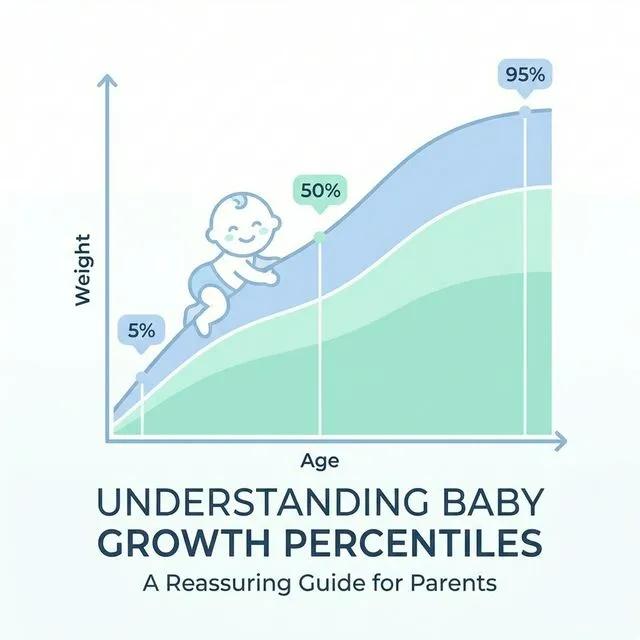
When the pediatrician says 'your baby is in the 25th percentile', many parents worry thinking it's a low grade. However, in pediatrics, percentiles are not like school exams. A child in the 10th percentile can be just as healthy as one in the 90th, provided they follow their own progression.
What Exactly Is a Percentile?
It is simply a statistical measure. If your child is in the 25th percentile for weight, it means that out of 100 healthy children of the same age and sex, 25 weigh less than them and 75 weigh more. Percentiles are derived from large population studies — the WHO Growth Standards, for example, are based on the Multicentre Growth Reference Study (MGRS) that followed over 8,400 breastfed children across six countries (Brazil, Ghana, India, Norway, Oman, and the United States).
Basic Interpretation
Normal Range
3rd to 97th
Almost all healthy children are born and grow within this wide margin.
Midpoint
50th
Indicates the average value for the population of that age.
Below 3rd or Above 97th
Further evaluation
Values outside this range may warrant additional clinical assessment, though they do not automatically indicate a problem.
Why the Trend Is Key
What really matters to health professionals is that growth is stable. A sharp change in percentile (e.g., dropping from 80th to 15th in a few months) is usually more relevant than consistently being in a low percentile since birth. Pediatricians refer to this as 'crossing percentile lines' — when a child's measurement crosses two or more major percentile lines on the chart, it triggers a clinical review.
It is normal for some shifting to occur in the first two years of life as a child settles into their genetically determined growth channel. A study published in Pediatrics (Mei et al., 2004) found that crossing two major percentile lines is very common early on: between birth and 6 months it happened to 39% of children for weight-for-age and 32% for length-for-age, falling to 1-5% for weight between 24 and 60 months. After age two, growth trajectories tend to stabilize, and significant crossing becomes more clinically meaningful.
Important Fact
Factors like parental genetics, nutrition, and episodes of illness can temporarily alter the curve without signifying a chronic problem. Premature babies, for example, should be plotted using their corrected age (subtracting the number of weeks born early) until at least 24 months.
WHO Charts vs CDC Charts: Which Should You Use?
Two main sets of growth charts are used internationally. The WHO Growth Standards (2006) describe how children should grow under optimal conditions — they are based on breastfed infants in healthy environments and are recommended for children aged 0 to 5. The CDC Growth Charts (2000) describe how children did grow in the United States during a specific time period and are typically used for children aged 2 to 20.
The American Academy of Pediatrics (AAP) and the WHO recommend using WHO charts for children under two because they set breastfeeding as the normative standard. After age two, many clinicians switch to CDC charts. In practice, differences between the two are small, but it is important to use the same chart consistently so that trend comparisons remain valid.
What Parameters Are Measured?
Growth monitoring involves several measurements, each captured on its own percentile chart. The three core parameters are weight-for-age, length/height-for-age, and head circumference-for-age. For children over two, BMI-for-age is also tracked. Each parameter tells a different part of the story — for example, a child may be in the 20th percentile for weight but the 60th for height, simply reflecting a naturally lean build.
Key growth parameters tracked by percentile
- Weight-for-age — the most commonly discussed, but can be misleading without height context
- Length/Height-for-age — reflects long-term nutritional status and genetic potential
- Head circumference-for-age — important in the first three years for brain development monitoring
- BMI-for-age (from age 2) — helps identify underweight, overweight, and obesity risk
- Weight-for-length (under 2) — a better indicator of body proportion than weight alone
When Should Parents Be Concerned?
Most percentile variations are perfectly normal. However, certain patterns warrant a conversation with your pediatrician. These include a sustained drop across two or more major percentile lines over several months, weight-for-length consistently below the 3rd or above the 97th percentile, or a head circumference that deviates significantly from the child's previous trajectory.
Signs that merit a pediatric discussion
- Sustained crossing of two or more percentile lines in a downward or upward direction
- Weight stalling while height continues to increase normally
- Head circumference growing much faster or slower than expected
- Significant discrepancy between weight and height percentiles that develops over time
- Any abrupt change in growth pattern after a period of illness or dietary change
Practical Tips for Accurate Measurement
The accuracy of percentile tracking depends entirely on correct measurements. Children under two should be measured lying down (recumbent length), while those over two are measured standing (height). Using the wrong method can create a false impression of percentile crossing. Weigh infants without clothing or a diaper, and always use calibrated equipment.
If you are tracking growth at home between pediatric visits, try to measure at the same time of day and under similar conditions. A single measurement is a snapshot — it is the collection of data points over months and years that reveals the true growth pattern.
How to Use Our Tools
You can use our percentile calculator to keep track between pediatrician visits. You just need sex, exact age, and weight or height measurements. The calculator uses the official WHO reference data and instantly shows where your child falls on the growth curve. Remember, however, that home tracking is a complement to — not a replacement for — regular professional checkups.

Sources