Pediatrics
Khamis-Roche vs Bone Age X-Ray: Which Is Better?
Compare the two most common methods for predicting adult height -- the Khamis-Roche formula and bone age X-ray -- and find out when each one is most accurate.
Free online tool
Height predictor
Two approaches, one question
Will my child be tall? It is one of the most common questions parents ask pediatricians. Two evidence-based methods dominate the field of height prediction: the Khamis-Roche formula, which uses simple measurements and parent heights, and bone age assessment via X-ray, which examines skeletal maturation. Both have strengths, both have limitations, and understanding the difference can help you interpret your child's predicted adult height more realistically.
How the Khamis-Roche method works
Published in 1994 by Harry J. Khamis and Alex F. Roche, this method predicts adult stature using the child's current height, current weight, and the heights of both biological parents. It was developed using data from the Fels Longitudinal Study, one of the longest-running growth studies in the world, which followed participants from birth through adulthood.
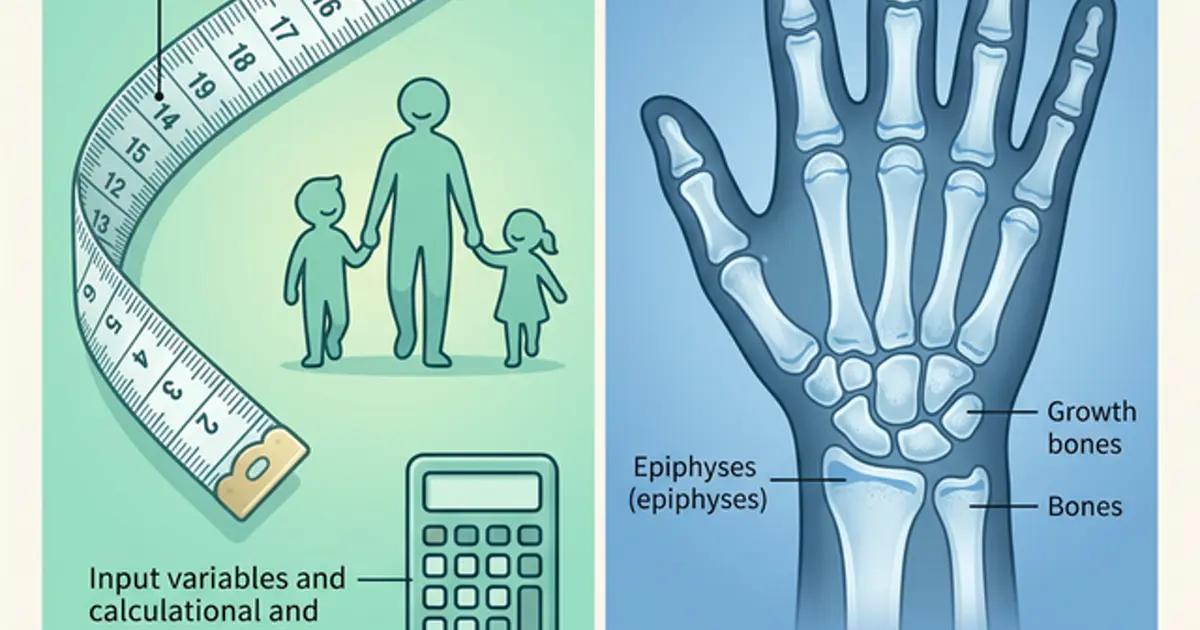
The formula applies age- and sex-specific regression coefficients to the input values. It does not require any medical imaging, blood tests, or clinic visits -- just a tape measure, a scale, and knowledge of parental heights. The method is validated for children aged 4 to 17.5 years.
Try the Khamis-Roche predictor
Estimate your child's adult height with the Khamis-Roche method — enter age, sex, current height and weight and both parents' heights, no X-ray needed. Instant result with a confidence range.
Open the Khamis-Roche height predictor →Khamis-Roche at a glance
Inputs needed
Height, weight, parent heights
No imaging or lab work required.
Accuracy
About ±5 cm
Its authors found its errors only slightly larger than those of a method that uses bone age (RWT).
Age range
4 to 17.5 years
Works best from age 8 onward when growth patterns stabilize.
Cost
Free
Can be done at home with basic measurements.
How bone age X-ray works
Bone age assessment uses an X-ray of the left hand and wrist to evaluate skeletal maturity. The most common reference systems are the Greulich-Pyle atlas, which compares the X-ray to a series of standard images, and the Tanner-Whitehouse method, which scores individual bones numerically.
Once the bone age is determined, the Bayley-Pinneau tables or similar methods use the ratio of current height to predicted percentage of mature height to estimate final adult stature. If a child's bone age is younger than their chronological age, they likely have more growth potential remaining. If bone age is advanced, they may reach adult height sooner but with a lower final value.
Bone age method at a glance
Inputs needed
Hand/wrist X-ray + current height
Requires a radiology visit and physician interpretation.
Accuracy
Depends on the method
Varies by method and reader experience. Automated systems are improving consistency.
Age range
2 to 18 years
Most useful between ages 6 and 14.
Cost
Variable
Involves X-ray fees and radiology interpretation. Insurance coverage varies.
Accuracy comparison
In the original paper, the errors of the Khamis-Roche method were only slightly larger than those of the Roche-Wainer-Thissen method, which does use skeletal age. Bone age methods, while clinically valuable, introduce additional sources of variability: inter-reader disagreement on bone maturity, the quality of the X-ray image, and the reference tables used.
Importantly, bone age shines in clinical scenarios where growth is disordered -- conditions like precocious puberty, growth hormone deficiency, or constitutional delay -- where Khamis-Roche assumptions about normal growth patterns may not hold.
Pros and cons
Khamis-Roche advantages
Non-invasive
No radiation exposure
Suitable for routine use and parental curiosity without any health risk.
Free and instant
No clinic visit needed
Can be calculated at home with our online calculator.
Reproducible
No reader bias
Same inputs always produce the same output, unlike X-ray interpretation.
Bone age advantages
Clinical insight
Detects growth disorders
Can reveal conditions like precocious puberty or growth hormone deficiency.
Maturity-adjusted
Accounts for early/late developers
A late bloomer with younger bone age will get a higher predicted height than Khamis-Roche might suggest.
Broader indications
Works for atypical growth
Useful when growth patterns deviate significantly from normal trajectories.
When to use each method
For healthy children following a normal growth trajectory, the Khamis-Roche method is an excellent first-line tool. It is free, instant, requires no radiation, and has comparable accuracy to bone age in typical populations. Use it to get a reasonable estimate without a medical visit.
Bone age X-ray is more appropriate when there is clinical suspicion of a growth disorder, when the child is growing significantly faster or slower than expected, when puberty appears unusually early or late, or when a medical decision (such as growth hormone therapy) depends on the height prediction. In these cases, the additional information about skeletal maturity justifies the cost and radiation exposure.
In many pediatric endocrinology clinics, both methods are used together. The Khamis-Roche gives a baseline prediction assuming normal development, while the bone age provides a maturity-corrected estimate. Comparing the two can reveal whether a child's growth pattern is typical or warrants further investigation.
Try our free height predictor
Our Child Height Predictor Calculator uses the Khamis-Roche method to estimate your child's adult height in seconds. Just enter age, sex, current height and weight, and parent heights. No sign-up or X-ray needed.
Key takeaways
- Khamis-Roche is free, non-invasive, and accurate to about ±5 cm.
- Bone age X-ray adds clinical value when growth disorders are suspected but introduces reader variability.
- For healthy children, both methods produce similar accuracy ranges.
- Bone age is essential when medical decisions depend on height predictions.
- Using both methods together gives the most complete picture.
Sources
- Khamis HJ, Roche AF. Predicting adult stature without using skeletal age. Pediatrics. 1994.
- Greulich WW, Pyle SI (1959). Radiographic Atlas of Skeletal Development of the Hand and Wrist. 2nd ed. Stanford, CA: Stanford University Press.
- Roche AF, Wainer H, Thissen D. The RWT method for the prediction of adult stature. Pediatrics. 1975.
- Thodberg HH et al. The BoneXpert method for automated bone age determination. IEEE Trans Med Imaging. 2009.