Pediatric growth
Target Height: How to Predict Your Child's Adult Stature
Learn how target height (mid-parental height) is calculated, how it compares to the Khamis-Roche method, and what factors really influence your child's final height.
Free online tool
Height predictor
What is target height?
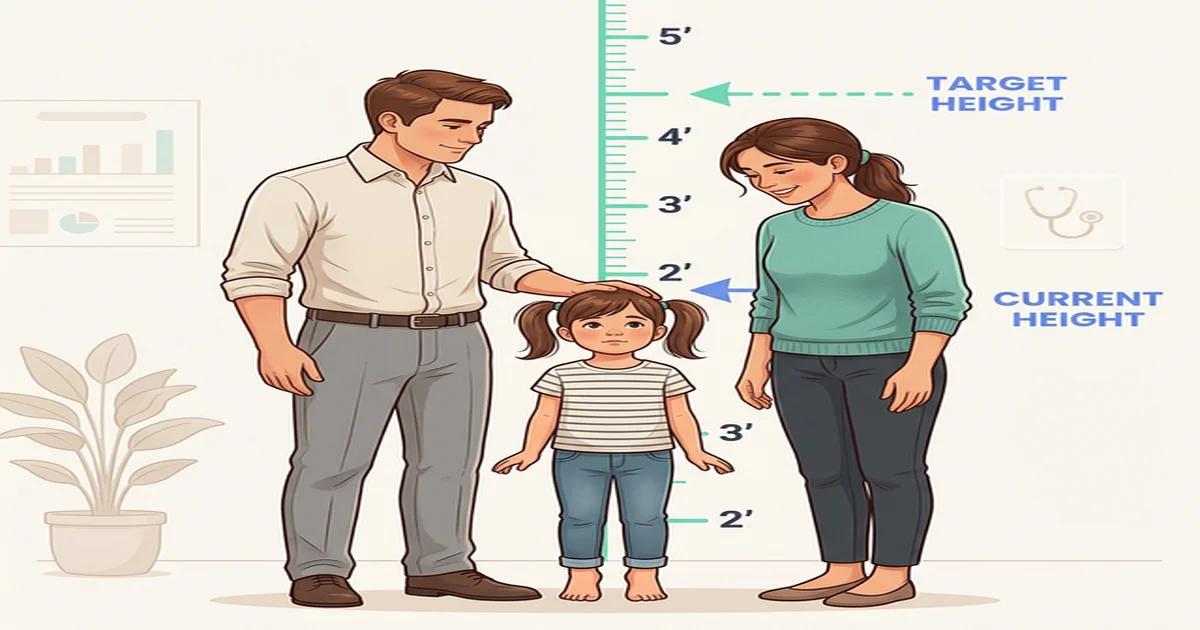
Target height — also called mid-parental height or genetic height potential — is a clinical estimate of the adult stature a child is likely to reach based on the heights of both biological parents. Pediatricians and endocrinologists use it as a quick screening tool to determine whether a child's growth is tracking within a genetically expected range.
The concept rests on a straightforward observation: tall parents tend to have tall children, and shorter parents tend to have shorter children. While this does not account for every variable, it gives clinicians a baseline against which to evaluate a child's growth chart position. When a child's projected height falls well outside the target range, further investigation — including bone age X-rays or hormone testing — may be warranted.
In Spanish-speaking countries the term 'talla diana' is widely used in pediatric consultations, and it remains one of the most searched health queries by parents. Whether you know it as target height, talla diana, mid-parental height, or genetic height potential, the underlying principle is the same: parental stature provides the strongest single predictor of a child's adult height.
Predict adult height without an X-ray
Beyond the mid-parental formula, the Khamis-Roche method estimates your child's adult height from their age, sex, current height and weight and both parents' heights. See both estimates in seconds.
Open the Khamis-Roche height predictor →The mid-parental height formula
The most widely used formula in clinical practice is the Tanner mid-parental height method. It adjusts for the average height difference between males and females (approximately 13 cm or 5 inches) and then averages the parents' heights.
How the calculation works
- For boys: (father's height + mother's height + 13 cm) ÷ 2
- For girls: (father's height + mother's height − 13 cm) ÷ 2
- The result is the mid-parental target height.
- A range of ± 8.5 cm (± 3.3 inches) around this value covers about 95% of expected outcomes.
Important nuance
The mid-parental formula provides a population-level estimate with a wide confidence interval. It does not factor in the child's current height, weight, bone maturity, or pubertal status. For a more individualized prediction, methods like Khamis-Roche incorporate the child's own measurements.
In imperial units the correction factor is 5 inches instead of 13 cm. Some clinicians also use a simplified version where they simply average the parents' heights and add or subtract 6.5 cm, which gives exactly the same result.
It is worth noting that the mid-parental height formula was originally developed using European and North American populations. Its accuracy may vary across ethnic groups due to differences in body proportions and secular growth trends. Nevertheless, it remains a widely used first approximation in pediatric endocrinology.
Khamis-Roche vs. bone age methods
While the mid-parental formula is the quickest estimate, two other methods are commonly used in clinical and research settings to predict adult height with greater precision.
The Khamis-Roche method
Developed in 1994 by Harry J. Khamis and Alex Roche, this method predicts adult stature without requiring a bone age X-ray. It uses the child's current height, current weight, and the heights of both parents, plugged into sex- and age-specific regression equations derived from the Fels Longitudinal Study — one of the longest-running growth studies in the world, tracking participants from birth to adulthood since 1929.
In the original paper, the errors of the Khamis-Roche method were only slightly larger than those of the Roche-Wainer-Thissen method, which uses bone age, and its range is much narrower than the ±8.5 cm of the mid-parental formula. Accuracy improves as the child ages: predictions made at age 12 are notably more reliable than those at age 5, because a larger proportion of adult height has already been achieved.
Prediction methods compared
Mid-parental (Tanner)
± 8.5 cm
Wide 95% confidence interval; uses only parental heights.
Khamis-Roche
About ± 5 cm
No X-ray needed; uses child's current height, weight, and parental heights.
Greulich-Pyle / TW3
Bone age only
Assesses skeletal maturity from a hand and wrist X-ray; the height prediction itself comes from tables such as Bayley-Pinneau.
Bayley-Pinneau
Needs bone age
Tables that combine bone age and current height; requires an X-ray.
Bone age-based predictions
Methods like Greulich-Pyle and Tanner-Whitehouse (TW3) use a left hand and wrist X-ray to assess skeletal maturity. A child whose bone age is delayed relative to chronological age generally has more growth potential remaining, and vice versa. These methods are the gold standard in pediatric endocrinology but require imaging, making them impractical for routine screening.
The Khamis-Roche method strikes a practical balance: it is substantially more accurate than the mid-parental formula, yet it requires no radiation exposure and can be calculated at home or in a standard checkup. This is the method behind our child height predictor calculator.
Factors that influence final height
Genetics account for an estimated 60–80% of height variation, but the remaining 20–40% is shaped by environment and lifestyle. Understanding these modifiable factors helps parents support their child's growth potential.
Nutrition
Chronic malnutrition — particularly protein and micronutrient deficiency — is the leading non-genetic cause of stunted growth worldwide. Key nutrients for linear growth include:
- Protein: essential for growth hormone signaling and tissue synthesis.
- Calcium and vitamin D: critical for bone mineralization and longitudinal bone growth.
- Zinc: deficiency is associated with reduced growth velocity in children.
- Iron: chronic iron-deficiency anemia can impair growth and development.
- Vitamin A: supports bone remodeling and immune function.
Sleep and growth hormone
Growth hormone (GH) is released in pulsatile bursts, with the largest peaks occurring during deep slow-wave sleep. However, studies have not shown that sleeping a little less than recommended reduces a child's final height. The American Academy of Sleep Medicine recommends 9–12 hours of sleep per night for children aged 6–12, and 8–10 hours for teenagers.
Physical activity and chronic illness
Weight-bearing exercise stimulates bone growth plate activity, and regular physical activity is associated with better growth outcomes. Sports like swimming, basketball, and gymnastics are often recommended, though no specific sport has been proven to increase height beyond genetic potential.
Conversely, chronic diseases — celiac disease, inflammatory bowel disease, chronic kidney disease, and poorly controlled asthma requiring long-term corticosteroids — can significantly impair linear growth if left untreated. Early diagnosis and treatment of these conditions is essential, because catch-up growth is possible when the underlying cause is addressed before the growth plates close.
When height is concerning
Not every short child has a growth disorder, and not every tall child is growing abnormally. However, certain patterns warrant medical evaluation.
- Height below the 3rd percentile or above the 97th percentile for age and sex.
- Growth velocity below 4 cm per year after age 4 (before the pubertal growth spurt).
- Predicted adult height falling more than 2 standard deviations below the target height range.
- Crossing two or more major percentile lines on the growth chart after age 2.
- Significant discrepancy between bone age and chronological age (more than 2 years).
Constitutional delay vs. pathological short stature
Constitutional growth delay (also called 'late bloomers') is one of the most common causes of short stature in otherwise healthy children. These children enter puberty later than peers but eventually reach a normal adult height. A pediatric endocrinologist can distinguish this from conditions like growth hormone deficiency or Turner syndrome through targeted testing.
If your child's predicted height from our calculator falls outside the expected target range, it does not necessarily mean there is a problem — but it is a good reason to discuss the results with your pediatrician. In many cases, the evaluation will show normal growth velocity and no intervention will be needed.
Parents should also be aware that pubertal timing plays a significant role. Early puberty can lead to a taller stature during childhood but a shorter final adult height, because the growth plates fuse sooner. Conversely, delayed puberty typically results in a child who appears shorter during adolescence but may reach a taller final height as they continue growing for a longer period.
How the calculator works
Our child height predictor calculator uses the Khamis-Roche equations to estimate adult height. You simply enter the child's sex, current age, current height, current weight, and the heights of both biological parents. The algorithm applies age- and sex-specific coefficients to produce a predicted adult height along with a confidence margin.
- Enter the child's date of birth or age (between 4 and 17.5 years).
- Input the child's current height and weight.
- Provide the biological mother's and father's heights.
- Review the predicted adult height and the ± margin of error.
- Compare the result with the mid-parental target height shown alongside.
The calculator also displays the mid-parental target height for reference, so you can see both estimates side by side. Remember that predictions become more accurate as the child gets older and approaches their final height.
Try our child height predictor calculator to get a personalized estimate for your child. It takes less than a minute and requires no medical tests — just the measurements you likely already know.
Target height is a valuable first step in understanding your child's growth trajectory. While no formula can guarantee an exact outcome, combining the mid-parental estimate with the Khamis-Roche prediction gives parents and clinicians a practical, evidence-based framework. Track your child's growth over time, ensure adequate nutrition and sleep, and consult a specialist if the numbers raise any concerns.
Sources
- Khamis HJ, Roche AF. Predicting adult stature without using skeletal age. Pediatrics. 1994;94(4):504–507.
- Tanner JM, Goldstein H, Whitehouse RH. Standards for children's height at ages 2–9 years allowing for height of parents. Arch Dis Child. 1970;45(244):755–762.
- Wit JM, Clayton PE, Rogol AD, et al. Idiopathic short stature: definition, epidemiology, and diagnostic evaluation. Growth Horm IGF Res. 2008;18(2):89–110.
- Greulich WW, Pyle SI (1959). Radiographic Atlas of Skeletal Development of the Hand and Wrist. 2nd ed. Stanford, CA: Stanford University Press.
- Paruthi S, et al. Recommended amount of sleep for pediatric populations. J Clin Sleep Med. 2016;12(6):785–786.