Body composition
Body Roundness Index (BRI): What Your Score Really Means
The Body Roundness Index (BRI) estimates central body fat from your height and waist circumference, modeling the body as an ellipse instead of BMI's simple weight-for-height ratio. Learn how BRI is calculated, how to read the bands, what the landmark mortality research found, and where the score falls short.
Free online tool
Body Roundness Index (BRI)
What Is the Body Roundness Index?
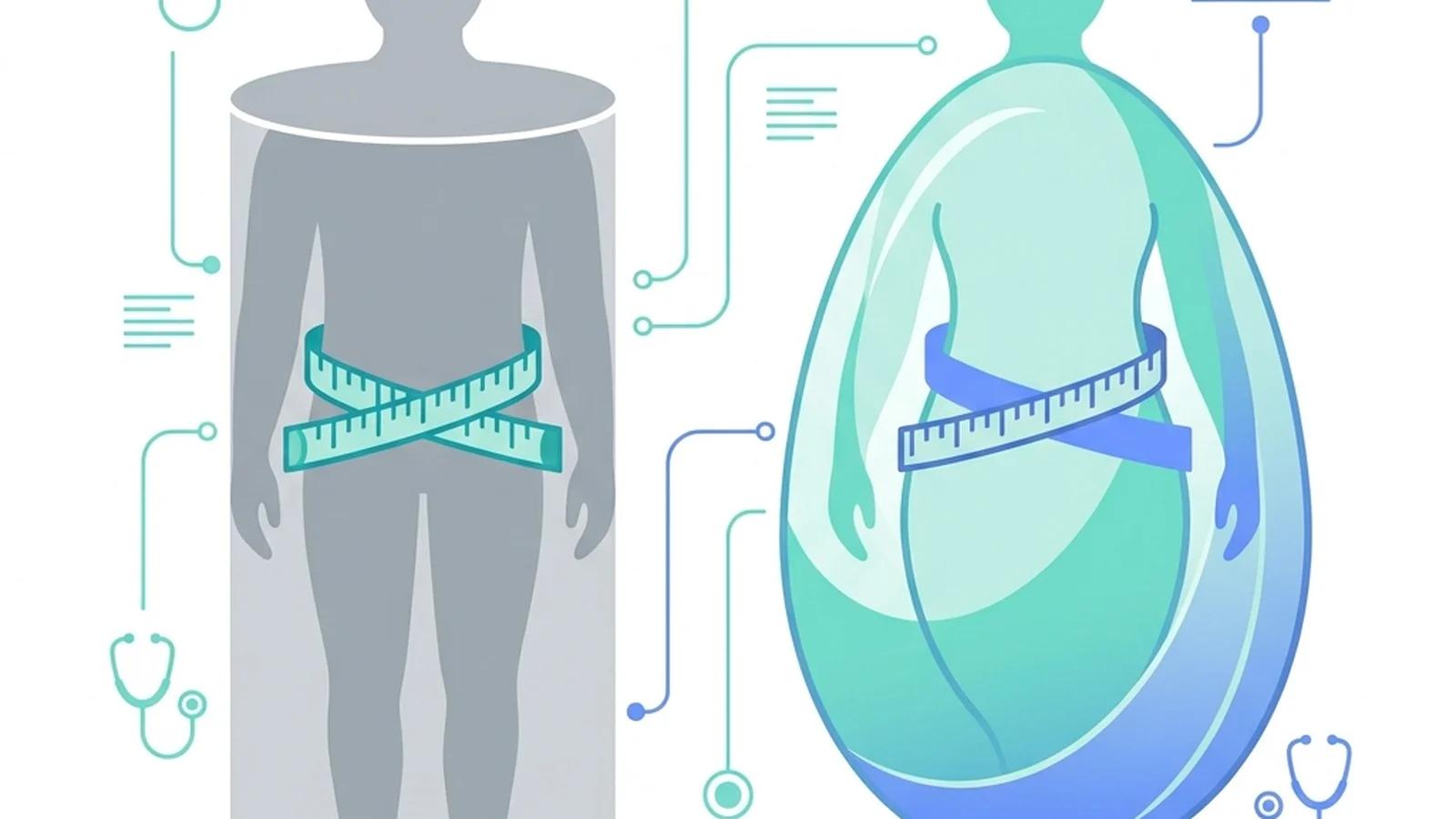
The Body Roundness Index (BRI) is a body-shape metric that estimates the proportion of body fat — and central (abdominal) fat in particular — from just two measurements: height and waist circumference. It was developed by Diana Thomas and colleagues in 2013, who reasoned that the human body is better approximated by an ellipse than by the tall cylinder implied by traditional weight-for-height indices. BRI turns the 'roundness' of that ellipse into a single number, most commonly falling between about 1 and 16.
Roundness vs. BMI: A Different Geometry
The body mass index (BMI) divides weight by height squared. It captures overall size but is blind to where fat sits: two people with an identical BMI can have very different waistlines, and it is central fat that carries most of the metabolic risk. BRI takes a different route. By combining waist circumference with height, it estimates the eccentricity of the ellipse that best fits the torso — in plain terms, how round versus how slender the body is. A rounder profile (a larger waist relative to height) produces a higher BRI and, on average, a larger share of visceral fat.
The BRI Formula
BRI is derived from the geometry of an ellipse, using waist circumference and height expressed in the same units (metres). The equation is: BRI = 364.2 − 365.5 × √(1 − (waist ÷ (π × height))²). The ratio waist ÷ (π × height) is the eccentricity term; as the waist grows relative to height, the value under the square root shrinks and BRI rises. Because both measurements share the same units, the result is a pure shape index with no direct dependence on body weight.
Measuring your waist correctly
Take the waist measurement at the midpoint between the lowest rib and the top of the hip bone (iliac crest), at the end of a normal breath, with the tape snug but not compressing the skin. A poorly placed tape is the single largest source of error in any waist-based index.
How to Read Your BRI
General BRI bands
BRI below 4.5
Lower roundness
A leaner, more elongated body profile with a smaller waist relative to height. A very low BRI is not automatically 'better' — see the mortality findings below.
BRI 4.5 – 6.9
Intermediate
A middle range where the waist-to-height proportion is typical for many adults. Interpret it alongside blood pressure, glucose and lipids, not in isolation.
BRI 6.9 and above
Higher roundness
A rounder profile indicating a larger waist relative to height and, on average, more central and visceral fat — the depot most linked to cardiometabolic risk.
Interpreting Your Score
BRI is an associational, population-level indicator — not a diagnosis. There is no single, universally agreed clinical cut-off: the bands above are approximate and were derived largely from population percentiles, so what counts as 'high' varies with age, sex, ethnicity and the reference group. A BRI value describes body shape and estimates fat distribution; on its own it neither confirms nor rules out any medical condition. Treat it as one signal among many — most useful for tracking change in yourself over time.
What the Research Shows
In the original 2013 work, BRI predicted percentage body fat and visceral adipose tissue in a large US cohort, validating it as a practical proxy for fat distribution. More recently, a 2024 analysis of the US NHANES survey (roughly 33,000 adults followed over nearly two decades, published in JAMA Network Open) examined BRI against death from any cause. The striking result was a U-shaped relationship: all-cause mortality risk was elevated both at the highest BRI values and at the very lowest, with the lowest risk in the middle of the distribution.
Why the U-shape matters
A very low BRI is not a target to chase. The raised risk at the low end is thought to reflect underweight, muscle loss and underlying illness rather than a benefit of extreme leanness. The healthiest range appears to be intermediate — another reason to read BRI in clinical context rather than driving the number ever lower.
Limitations
Keep these caveats in mind
- It relies entirely on an accurate waist measurement; tape placement and breathing state can shift the result substantially.
- It does not distinguish subcutaneous from visceral fat directly, nor fat from muscle — it only estimates shape.
- Cut-offs are not standardized across ages, sexes or ethnic groups, so cross-population comparisons are unreliable.
- Like BMI, it can misclassify very muscular or unusually tall or short individuals.
- It is a research and screening tool, not a diagnostic test.
When to See a Doctor
Use BRI as a prompt for conversation, not a verdict. Talk to a clinician if your waist circumference is high (broadly, above about 102 cm / 40 in for men or 88 cm / 35 in for women), if your BRI has risen sharply, or if you also have raised blood pressure, blood sugar or cholesterol, a family history of heart disease or type 2 diabetes, or unexplained weight change. A professional can order the tests that BRI can only hint at and place the number in the context of your whole health.
Estimate your Body Roundness Index
Enter your height and waist to get your BRI and see which band it falls in.
Open the Body Roundness Index calculatorSources
- Thomas DM, Bredlau C, Bosy-Westphal A, et al. Relationships between body roundness with body fat and visceral adipose tissue emerging from a new geometrical model. Obesity (Silver Spring). 2013;21(11):2264-2271. PMID: 23519954
- Zhang X, Ma N, Lin Q, et al. Body Roundness Index and All-Cause and Cardiovascular Mortality Among US Adults. JAMA Netw Open. 2024;7(6):e2415051. PMID: 38837158