Metabolism
Indirect Calorimetry: Measuring Metabolism Beats Guessing
Predictive formulas estimate your calorie needs from height, weight and age. Indirect calorimetry measures them directly from the air you breathe — and the difference can be large.

Free online tool
Indirect calorimetry (resting energy)
When you want to know how many calories your body burns, there are two very different ways to get a number. You can estimate it from a formula based on your height, weight, age and sex — or you can measure it directly. Indirect calorimetry is the measurement approach, and it is considered the clinical gold standard for determining how much energy a person burns at rest.

What indirect calorimetry actually measures
Indirect calorimetry does not measure heat directly. Instead, it measures the oxygen you consume (VO2) and the carbon dioxide you produce (VCO2) while you lie still, usually through a mask, hood or mouthpiece connected to a metabolic cart. Because burning fuel for energy consumes oxygen and releases carbon dioxide in predictable proportions, these two gas-exchange values can be converted into the rate at which your body is releasing energy — your Resting Energy Expenditure (REE).
REE (sometimes called Resting Metabolic Rate, RMR) is the energy your body uses simply to stay alive at complete rest: to keep the heart beating, the lungs moving, the brain working and cells maintained. For most people it is the single largest component of daily calorie expenditure, typically accounting for around 60-70% of total energy used in a day.
The Weir equation: turning gas into calories
The conversion from gas exchange to calories is done with the Weir equation, published by J.B. de V. Weir in 1949 and still the standard in clinical practice today. It uses the measured oxygen consumption and carbon dioxide production to calculate energy expenditure, with a small optional correction for protein metabolism estimated from urinary nitrogen. In abbreviated form it is often written so that REE depends almost entirely on VO2 and VCO2, which is why accurate gas measurement is so important.
The key numbers
What is measured
VO2 (oxygen consumed) and VCO2 (carbon dioxide produced)
What is calculated
Resting Energy Expenditure (REE / RMR), in kcal/day
Share of daily burn
REE is typically about 60-70% of total daily energy expenditure
Why measuring beats estimating
Predictive equations such as Harris-Benedict and Mifflin-St Jeor estimate REE from population averages. They are convenient, but they carry substantial error for any individual. The Mifflin-St Jeor equation (1990) is generally regarded as the most accurate of the predictive formulas, yet a systematic review (Frankenfield 2005) found that even this equation misses the measured value by more than 10% in a meaningful share of people, and individual errors can be large. A formula cannot know that your metabolism runs unusually high or low; only measurement can.
If you have your measured VO2 and VCO2 from a metabolic test, you can turn them into REE, a respiratory quotient and fuel-use estimates with our calculator — built on the Weir and Frayn equations.
Open the indirect calorimetry calculator →This is exactly why the 2023 ESPEN clinical nutrition guideline recommends indirect calorimetry, rather than predictive equations, to set energy targets for critically ill patients in the intensive care unit, where over- or under-feeding both cause harm. The same logic applies in less extreme settings: when the number matters, measuring it is better than guessing it.
The respiratory quotient: which fuel you are burning
Indirect calorimetry yields a second useful number: the Respiratory Quotient (RQ), the ratio of carbon dioxide produced to oxygen consumed (VCO2 / VO2). Because fat and carbohydrate burn with different amounts of oxygen, the RQ tells you roughly which fuel your body is using at rest.
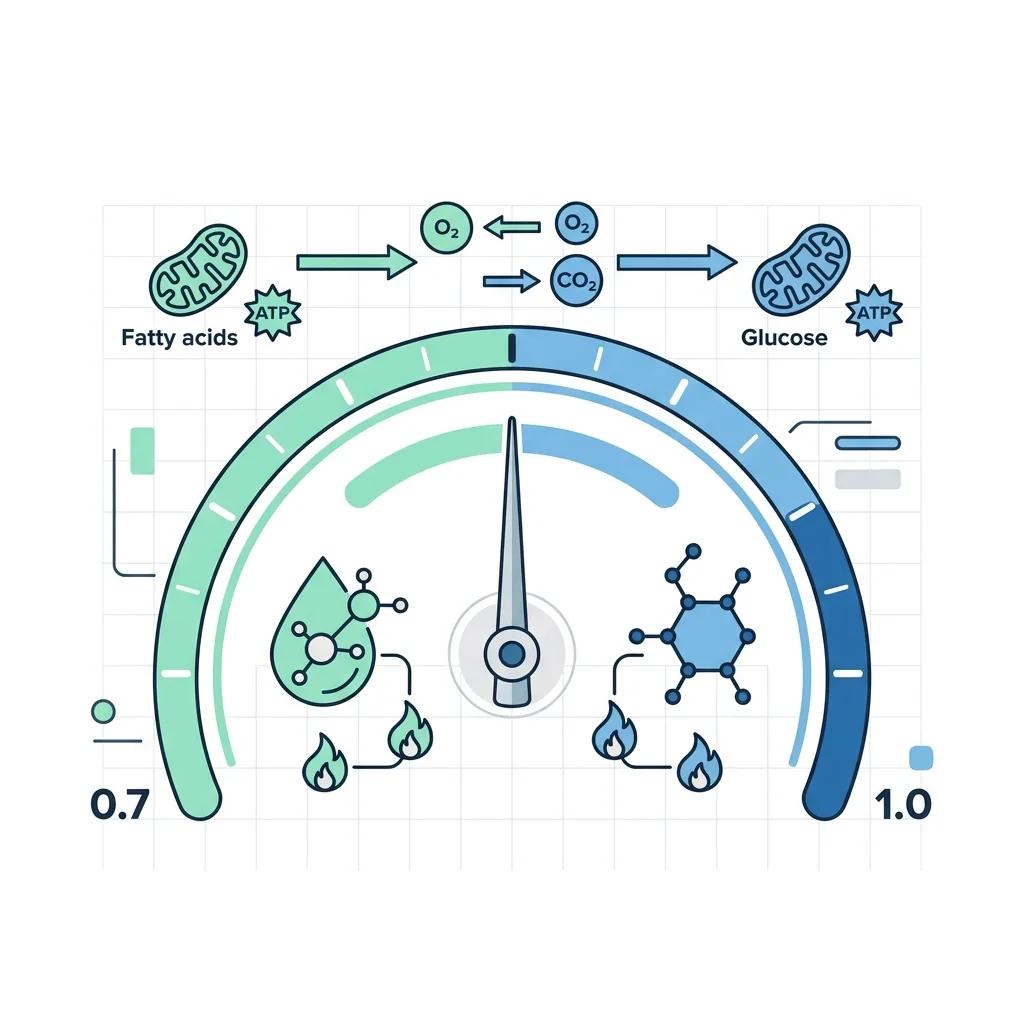
Reading the respiratory quotient (RQ)
RQ around 0.7 — mostly fat
An RQ near 0.7 indicates that fat is the dominant fuel being oxidised, as seen after fasting or on a very low-carbohydrate intake.
RQ around 0.85 — mixed
A value near 0.85 reflects a balanced mix of fat and carbohydrate, typical of an ordinary mixed diet.
RQ around 1.0 — mostly carbohydrate
An RQ approaching 1.0 means carbohydrate is the main fuel, as after a carbohydrate-rich meal.
Reference tables for converting the non-protein RQ into a precise fat-to-carbohydrate mix were refined by Peronnet and Massicotte (1991). Educationally, the RQ is often discussed as a window onto metabolic flexibility — how readily the body shifts between burning fat and carbohydrate — although on its own it is a snapshot, not a diagnosis.
From gas exchange to grams of fuel
Going one step further, the gas-exchange values can be converted into actual substrate oxidation rates — how many grams of fat and how many grams of carbohydrate you are burning per day. The standard method was published by Frayn in 1983, which derives carbohydrate and fat oxidation in grams per minute (and per day) from VO2, VCO2 and an estimate of protein oxidation. This is what turns an abstract calorie figure into a concrete picture of what your body is actually using for fuel.
Where this is useful
Weight management and dieting: knowing your real REE lets you set a calorie target from your true maintenance level rather than a population guess, which makes a deficit or surplus far more predictable.
Sport and performance: athletes use the RQ and substrate-oxidation data to understand fuel use and fat-burning capacity at rest, which informs nutrition and training periodisation.
Longevity and healthy ageing: resting metabolic rate is one marker that researchers track as part of metabolic health, so a measured REE can serve as a personal baseline to monitor over time.
Clinical and health settings: in hospital nutrition, surgery recovery and managing chronic conditions, an accurate measured energy requirement helps avoid both over- and under-feeding.
Bottom line
Indirect calorimetry replaces an estimate with a measurement: it reads the oxygen you breathe in and the carbon dioxide you breathe out, then uses the Weir equation to compute your resting energy expenditure and the respiratory quotient to reveal which fuel you burn. It is the gold standard precisely because formulas, however convenient, can be far off for any one person.
This article is for education only and is not medical advice. Indirect calorimetry results and the calculations derived from them are tools to inform a conversation with a qualified professional, not a substitute for individual clinical or dietetic assessment. Reviewed by Dr. Ibanez.
Sources
- Weir JB. (1949). New methods for calculating metabolic rate with special reference to protein metabolism. J Physiol 109(1-2):1-9.
- Frayn KN. (1983). Calculation of substrate oxidation rates in vivo from gaseous exchange. J Appl Physiol 55(2):628-634.
- Mifflin MD, St Jeor ST, et al. (1990). A new predictive equation for resting energy expenditure in healthy individuals. Am J Clin Nutr 51(2):241-247.
- Singer P, et al. (2023). ESPEN practical and partially revised guideline: Clinical nutrition in the intensive care unit. Clin Nutr 42(9):1671-1689.
- Du Bois D, Du Bois EF. (1916). A formula to estimate the approximate surface area if height and weight be known. Arch Intern Med 17:863-871.
- Peronnet F, Massicotte D. (1991). Table of nonprotein respiratory quotient: an update. Can J Sport Sci 16(1):23-29.
- Frankenfield D, Roth-Yousey L, Compher C. (2005). Comparison of predictive equations for resting metabolic rate in healthy nonobese and obese adults: a systematic review. J Am Diet Assoc 105(5):775-789.