Endocrinology
HOMA-IR Explained: How a 1985 Equation Detects Insulin Resistance Years Before Diabetes
HOMA-IR takes two fasting numbers — glucose and insulin — and gives you an estimate of your insulin resistance that mirrors the gold-standard clamp test. Here is what it measures, what your number means, and where it stops working.
Free online tool
HOMA-IR insulin resistance
Insulin sensitivity is already falling steeply in the 5 years before type 2 diabetes is diagnosed (Tabák et al, Lancet 2009). For most of that time, your fasting glucose looks normal — the pancreas is silently working harder to keep it that way. The HOMA-IR index, derived from a 1985 mathematical model by Matthews and colleagues, captures that hidden compensatory work using just two numbers: fasting glucose and fasting insulin. This article explains exactly how it works, what your number means, and when not to use it.
Where the formula comes from
In 1985, David Matthews and colleagues at the Oxford Centre for Diabetes published 'Homeostasis model assessment: insulin resistance and beta-cell function from fasting plasma glucose and insulin concentrations in man' in Diabetologia (PMID 3899825). They built a computer model that simulated the feedback loop between liver glucose production, peripheral glucose uptake, and pancreatic insulin secretion. The model lets you ask: given a measured fasting glucose and a measured fasting insulin, what combination of insulin resistance and beta-cell function best explains them?
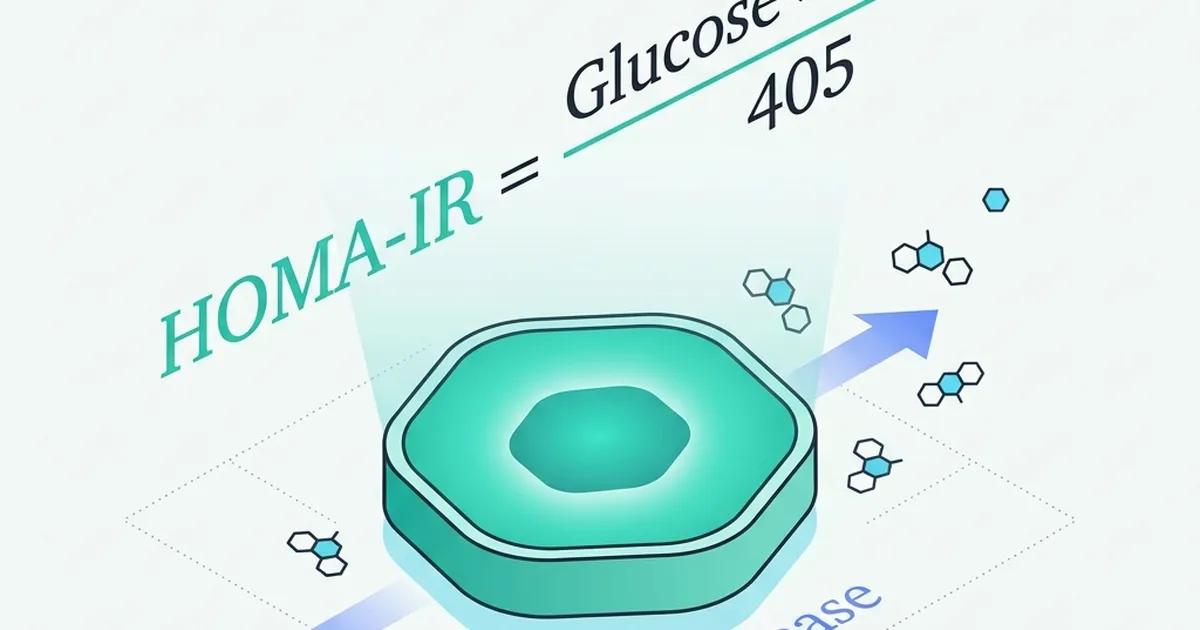
The full model is a nonlinear computer simulation. But Matthews et al also derived a closed-form approximation that captures most of the signal: HOMA-IR = (fasting glucose in mg/dL × fasting insulin in µU/mL) / 405. That single equation is what most labs and clinical research use. The simplicity is the strength: no oral glucose tolerance test, no IV insulin clamp, just one morning blood draw.
How it compares to the gold standard
The euglycemic-hyperinsulinemic clamp is the gold-standard measure of whole-body insulin sensitivity. It takes 4 hours, an IV insulin infusion, and continuous glucose monitoring with adjustable glucose infusion to keep blood sugar stable. It is wildly impractical outside a research lab. In 2000, Bonora and colleagues published in Diabetes Care (PMID 10857969) a head-to-head comparison: they ran HOMA-IR and the clamp on 115 subjects spanning the full glucose-tolerance spectrum. HOMA-IR closely tracked the clamp result (r ≈ 0.8) across normal, impaired-glucose-tolerance, and type 2 diabetic subjects. That validation is why HOMA-IR became the default insulin-resistance estimator in epidemiology and primary care.
Reading your number
HOMA-IR interpretation ranges
< 1.0 (Optimal)
Insulin-sensitive — athletes, metabolically healthy adults
1.0 – 2.49 (Normal)
Within the typical healthy-adult range
2.5 – 3.79 (Borderline)
Early insulin resistance — Bonora 1998 Bruneck Study ≈ 2.77
≥ 3.8 (High)
Clinical insulin resistance — elevated diabetes risk
There is no single universal cutoff for 'insulin resistance' — published values range from 2.0 to 3.8 depending on the cohort and the assay. We use the ranges most consistent with Bonora's published thresholds. Track your own value over time on the same lab; the trajectory matters more than the absolute number.
Why HOMA-IR rises before glucose does
The Whitehall II study (Tabák et al, Lancet 2009, PMID 19515410) followed thousands of British civil servants for over a decade and reverse-engineered the metabolic trajectory of those who eventually developed type 2 diabetes. Insulin sensitivity fell steeply during the 5 years before diagnosis. Glucose levels stayed normal because the pancreas compensated by secreting more insulin. Only when the beta cells could no longer keep up did fasting glucose rise. HOMA-IR — which integrates both glucose and insulin — captures that hidden compensation window when fasting glucose alone is still 'normal.' This is why a HOMA-IR of 3.5 with a glucose of 92 mg/dL is more informative than the 92 mg/dL alone.
When HOMA-IR is not reliable
Wallace and colleagues at Oxford (Diabetes Care 2004, PMID 15161807) wrote the definitive 'use and abuse' paper on HOMA. Three situations where the result becomes unreliable: (1) if you already have established type 2 diabetes — the equation assumes a roughly intact beta-cell response, which fails in advanced diabetes; (2) if you are on exogenous insulin — your measured insulin is no longer your own pancreas's output; (3) if your assay or lab changes — insulin immunoassays vary substantially between laboratories and even between assay generations within the same lab. For tracking your own trajectory, always use the same lab.
HOMA-IR vs FINDRISC vs HbA1c
Each test answers a different question. FINDRISC asks 'what is your 10-year probability of developing diabetes' based on your demographics and habits — no blood needed. HOMA-IR asks 'how hard is your pancreas working right now to keep your glucose normal' — needs fasting glucose plus insulin. HbA1c asks 'what is your average glucose over the past 3 months' — needs one blood draw, no fasting required. Use them together: FINDRISC for the population-level risk signal, HOMA-IR for the early metabolic signal, HbA1c for the current diagnostic threshold.
Bottom line
HOMA-IR is the most informative number you can extract from a basic fasting blood panel. It captures the silent compensatory phase that precedes diabetes by half a decade. It is not a diagnosis. It is a trajectory signal. A borderline or high HOMA-IR with a normal HbA1c means lifestyle intervention is the highest-leverage action you can take — the same intervention that cut diabetes incidence by 58% in the Finnish DPS (PMID 11333990) and the US DPP (PMID 11832527) trials. The math is on your side; the window is now.
Sources
- Matthews DR, Hosker JP, Rudenski AS, Naylor BA, Treacher DF, Turner RC (1985). Homeostasis model assessment: insulin resistance and beta-cell function from fasting plasma glucose and insulin concentrations in man. Diabetologia 28(7):412–419.
- Bonora E, Targher G, Alberiche M, et al. (2000). Homeostasis model assessment closely mirrors the glucose clamp technique in the assessment of insulin sensitivity. Diabetes Care 23(1):57–63.
- Wallace TM, Levy JC, Matthews DR (2004). Use and abuse of HOMA modeling. Diabetes Care 27(6):1487–1495.
- Tabák AG, Jokela M, Akbaraly TN, Brunner EJ, Kivimäki M, Witte DR (2009). Trajectories of glycaemia, insulin sensitivity, and insulin secretion before diagnosis of type 2 diabetes: an analysis from the Whitehall II study. Lancet 373(9682):2215–2221.