
HOMA-IR Calculator — Insulin Resistance Index
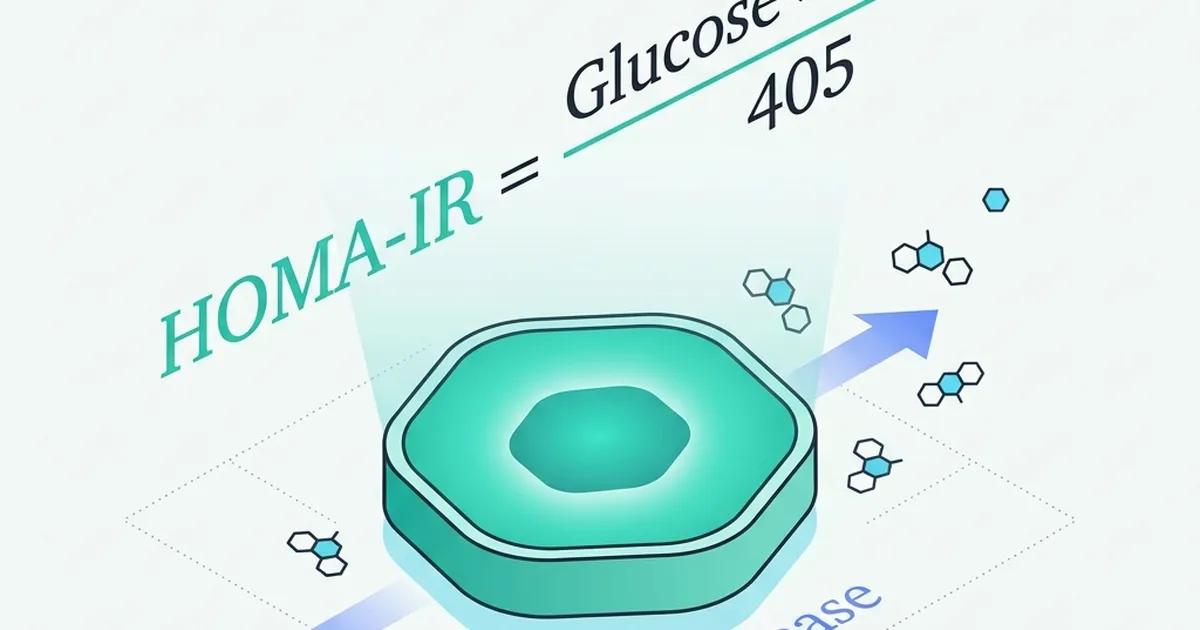
This calculator estimates insulin resistance with the HOMA-IR index from fasting glucose and fasting insulin: HOMA-IR = (glucose × insulin) / 22.5 (glucose in mmol/L) or / 405 (mg/dL). The higher the value, the more resistance; HOMA-IR can rise years before glucose or HbA1c. Interpretation ranges depend on the population and the lab, so discuss your value with your doctor.
Calculate your HOMA-IR from fasting glucose and fasting insulin. Validated against the euglycemic clamp (Bonora 2000). Detects insulin resistance years before diabetes.
CalcVita. (2026). HOMA-IR Calculator — Insulin Resistance Index. CalcVita. Retrieved October 18, 2026, from https://calcvita.com/en/calculators/homa-ir
Suggested article
HOMA-IR Explained: How a 1985 Equation Detects Insulin Resistance Years Before Diabetes
HOMA-IR takes two fasting numbers — glucose and insulin — and gives you an estimate of your insulin resistance that mirrors the gold-standard clamp test. Here is what it measures, what your number means, and where it stops working.
Read the full article →Key takeaways
- HOMA-IR (Matthews, 1985) estimates insulin resistance from fasting glucose and fasting insulin.
- Formula: (glucose × insulin) / 22.5 if glucose is in mmol/L, or / 405 if in mg/dL.
- A higher value means more resistance; it often rises before glucose or HbA1c.
- Thresholds vary by population and insulin assay — there is no universal cut-off.
How HOMA-IR works
The HOMA-IR (Homeostasis Model Assessment of Insulin Resistance) is a mathematical index developed by Matthews et al in 1985 to estimate insulin resistance and beta-cell function from a simple fasting blood draw. Thanks to its simplicity and validity it remains the most widely used method in clinical research and primary care.
Formula
HOMA-IR = (Fasting glucose mg/dL × Fasting insulin µU/mL) / 405. Higher values mean greater insulin resistance. Your HOMA-S (sensitivity) is 100/HOMA-IR, expressed as a percentage relative to a healthy reference adult. HOMA-β estimates pancreatic beta-cell function as a percentage relative to reference.
Interpretation ranges
- Optimal (< 1.0): High insulin sensitivity, healthy metabolic profile.
- Normal (1.0 – 2.49): Within the typical healthy-adult range.
- Borderline (2.5 – 3.79): Early signal of insulin resistance (Bonora 1998 Bruneck Study ≈ 2.77). Good window for intervention.
- High (≥ 3.8): Clinical insulin resistance. Elevated risk of prediabetes, metabolic syndrome and type 2 diabetes.
When HOMA-IR is not reliable
- Not valid if you are treated with insulin: the lab assay also measures the injected insulin (Wallace 2004).
- Requires that glucose and insulin be measured FASTING (8-12 hours without food).
- Analytical variability: insulin immunoassays vary between labs. Always use the same lab for comparisons.
- HOMA-IR does not diagnose diabetes — fasting glucose, HbA1c or an oral glucose tolerance test are the diagnostic tools.
Scientific sources (Tier-1)
- Matthews DR, Hosker JP, Rudenski AS, Naylor BA, Treacher DF, Turner RC (1985). Homeostasis model assessment: insulin resistance and beta-cell function from fasting plasma glucose and insulin concentrations in man. Diabetologia 28(7):412–419.
- Bonora E, Targher G, Alberiche M, et al. (2000). Homeostasis model assessment closely mirrors the glucose clamp technique in the assessment of insulin sensitivity. Diabetes Care 23(1):57–63.
- Bonora E, Kiechl S, Willeit J, et al. (1998). Prevalence of insulin resistance in metabolic disorders: the Bruneck Study. Diabetes 47(10):1643–1649.
- Wallace TM, Levy JC, Matthews DR (2004). Use and abuse of HOMA modeling. Diabetes Care 27(6):1487–1495.
- Tabák AG, Jokela M, Akbaraly TN, Brunner EJ, Kivimäki M, Witte DR (2009). Trajectories of glycaemia, insulin sensitivity, and insulin secretion before diagnosis of type 2 diabetes: an analysis from the Whitehall II study. Lancet 373(9682):2215–2221.
- Knowler WC et al. (2002). Reduction in the incidence of type 2 diabetes with lifestyle intervention or metformin. NEJM 346:393–403.
More calculators
Keep exploring helpful tools
FINDRISC diabetes risk
10-year type 2 diabetes risk score, no blood draw (Lindström 2003).
A1C to blood sugar (eAG)
Convert A1C to estimated average glucose using the ADAG formula (ADA 2024).
Cholesterol ratio
TC/HDL, LDL/HDL and non-HDL ratios with AHA/ACC 2018 classification.
Body inflammation
Assess your inflammation risk from diet and lifestyle.