
A1C to Blood Sugar Calculator — eAG Converter
Convert A1C to estimated Average Glucose (eAG) in mg/dL and mmol/L, or reverse-calculate A1C. ADAG formula with ADA 2024 classification.
Normal range: 4–5.6%. Range: 3–20%.
CalcVita. (2026). A1C to Blood Sugar Calculator — eAG Converter. CalcVita. Retrieved October 17, 2026, from https://calcvita.com/en/calculators/a1c
How to use the A1C converter
Select the conversion direction: A1C to Blood Sugar (enter your A1C percentage — found on your lab report as HbA1c) to see your estimated average glucose in both mg/dL and mmol/L, or Blood Sugar to A1C (enter your average glucose from 2–3 months of self-monitoring) to estimate your likely A1C. The result includes ADA 2024 risk classification and an A1C range chart.
The ADAG formula explained
eAG (mg/dL) = 28.7 × A1C% − 46.7. Published by Nathan DM et al. in Diabetes Care (2008) based on 507 participants from 10 international centres, combining continuous glucose monitoring with fingerstick readings. The reverse formula is: A1C% = (eAG + 46.7) / 28.7. To convert eAG to mmol/L: divide mg/dL by 18.018.
ADA 2024 A1C classification
Normal: A1C < 5.7% (eAG < 117 mg/dL / 6.5 mmol/L). Prediabetes: 5.7%–6.4% (eAG 117–137 mg/dL / 6.5–7.6 mmol/L). Diabetes: A1C ≥ 6.5% (eAG ≥ 140 mg/dL / 7.8 mmol/L). Diagnosis typically requires two abnormal results (on separate occasions) unless clear hyperglycaemia symptoms are present.
When to seek medical advice
See a doctor if your A1C is ≥ 5.7% and you have not been previously evaluated, or if your A1C is ≥ 6.5% on any test. Also seek evaluation for symptoms of hyperglycaemia: excessive thirst, frequent urination, unexplained fatigue, blurred vision, slow-healing wounds. A single calculator result is not a diagnosis — a lab A1C test and clinical evaluation are required.
Scientific References
- Nathan DM, Kuenen J, Borg R, et al. (2008). Translating the A1C Assay Into Estimated Average Glucose Values. Diabetes Care 31(8):1473–1478. PMID 18540046
- American Diabetes Association Professional Practice Committee (2024). Standards of Care in Diabetes — 2024. Diabetes Care 47(Suppl 1):S1–S321.
- American Diabetes Association (2010). Diagnosis and Classification of Diabetes Mellitus. Diabetes Care 33(Suppl 1):S62–S69.
- What is A1C and what does it measure?
- A1C (glycated haemoglobin, HbA1c) is a blood test that reflects your average blood glucose over the past 2–3 months. Glucose in the bloodstream binds to haemoglobin in red blood cells; since red cells live ~3 months, the percentage of glycated haemoglobin mirrors long-term glucose control. Unlike fasting glucose, A1C does not require fasting and is not affected by short-term fluctuations. It is the primary tool for diagnosing diabetes and monitoring treatment effectiveness.
- What is the ADAG formula used in this calculator?
- The ADAG (A1C-Derived Average Glucose) formula was developed from an international study (Nathan DM et al., 2008, Diabetes Care 31:1473-1478). It links A1C percentage to estimated Average Glucose (eAG): eAG (mg/dL) = 28.7 × A1C% − 46.7. The study combined continuous glucose monitoring with fingerstick self-monitoring (about 2,700 readings per person over 3 months) in 507 participants from 10 international centres to establish this linear relationship. The ADA recommends reporting eAG alongside A1C to make results more intuitive for patients, since mg/dL or mmol/L are the familiar units from self-monitoring devices.
- What are the ADA 2024 A1C thresholds for diabetes?
- According to the ADA Standards of Care in Diabetes — 2024: Normal A1C: below 5.7% (eAG < 117 mg/dL / 6.5 mmol/L). Prediabetes: 5.7%–6.4% (eAG 117–137 mg/dL / 6.5–7.6 mmol/L). Diabetes: 6.5% or above (eAG ≥ 140 mg/dL / 7.8 mmol/L). Unless there is unequivocal hyperglycaemia, the diagnosis requires two abnormal results, either from the same sample (e.g. A1C plus fasting glucose) or from two separate samples. These thresholds are based on the risk of developing diabetic retinopathy and other microvascular complications.
- How accurate is the eAG estimate from A1C?
- The ADAG formula gives a population-level estimate: in the study, the prediction error had a standard deviation of 15.7 mg/dL (0.87 mmol/L), so for an A1C of 7% the eAG of 154 mg/dL carries a 95% interval of 123–185 mg/dL (6.8–10.3 mmol/L). Individual variability is significant: some people have "high glycators" (A1C overestimates average glucose) and "low glycators" (A1C underestimates). Conditions affecting red blood cell lifespan — haemolytic anaemia, iron-deficiency anaemia, sickle cell disease, recent blood transfusion — can distort A1C results. In these cases, fructosamine or continuous glucose monitoring provide more reliable estimates.
- What is a good A1C target for people with diabetes?
- ADA 2024 recommends a general A1C target of < 7.0% (eAG < 154 mg/dL) for most non-pregnant adults with diabetes to minimise microvascular complications. Targets may be individualised: < 6.5% may be appropriate for selected patients (short diabetes duration, no CVD), while < 8.0% is reasonable for those with hypoglycaemia unawareness, limited life expectancy, or complex comorbidities. Discuss personalised targets with your diabetes care team. Remember: tighter control must be balanced against hypoglycaemia risk.
- Can I use blood glucose readings to estimate my A1C?
- Yes — this calculator supports the reverse conversion. The ADAG formula is bidirectional: A1C% = (eAG + 46.7) / 28.7. Enter your estimated average blood glucose (the average of many readings over 2–3 months) in mg/dL or mmol/L to get an approximate A1C. Self-monitoring averages are subject to testing bias (testing more when symptomatic), so this estimate is less reliable than a laboratory A1C. For an accurate A1C, a blood test is required every 3–6 months, as recommended by ADA for people with diabetes.
Suggested article
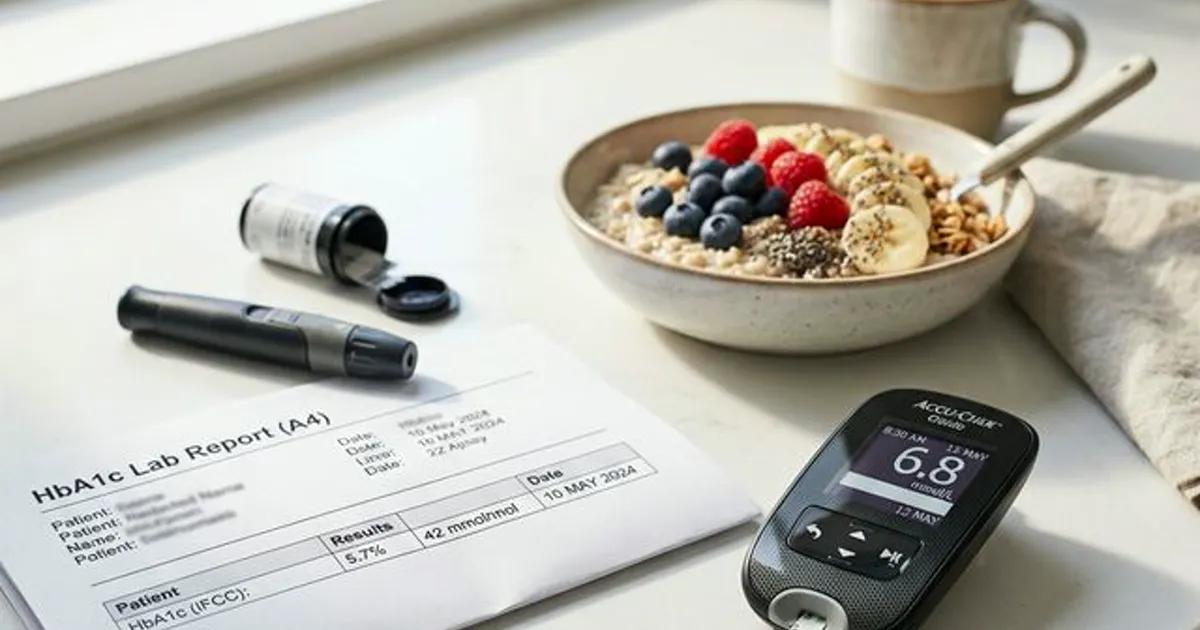
A1C and Blood Sugar: Understanding the ADAG Formula and ADA 2024 Thresholds
What does your A1C percentage mean in real blood sugar terms? Learn the ADAG formula that links A1C to estimated Average Glucose (eAG), the ADA 2024 diabetes thresholds, and when to seek medical advice.
Read the full article →More calculators
Keep exploring helpful tools
PREVENT Risk Calculator (AHA)
The successor to ASCVD (AHA 2023): 10- and 30-year risk with kidney function, no race.
Blood pressure
Classify your blood pressure using AHA 2017 guidelines.
eGFR — Kidney function
Glomerular filtration rate and CKD stage with CKD-EPI 2021 (KDIGO 2024).
Cholesterol ratio
TC/HDL, LDL/HDL and non-HDL ratios with AHA/ACC 2018 classification.