Hydration science
How Much Water Should You Really Drink Every Day?
Find your daily water target from your weight, activity, climate and life stage. See what the IOM and EFSA actually recommend, why the 8-glasses rule is a myth, and how to spot dehydration and overhydration early.
Free online tool
Water intake calculator
The "8 glasses a day" myth
Almost everyone has heard the advice: drink eight 8-ounce glasses of water a day. It is simple, memorable, and almost entirely unsupported by science. The recommendation appears to trace back to a 1945 report by the Food and Nutrition Board of the U.S. National Research Council, which stated that "a suitable allowance of water for adults is 2.5 liters daily in most instances." What people forget is the very next sentence: "Most of this quantity is contained in prepared foods." The advice was about total water, not glasses of plain water.
Fruits, vegetables, soups, and even coffee contribute to total fluid intake. A 2010 review published in Nutrition Reviews by Barry Popkin and colleagues found that roughly 20 to 30 percent of daily water comes from solid food in a typical Western diet, and even more in diets rich in fruits and vegetables. A landmark review by Heinz Valtin in the American Journal of Physiology (2002) concluded that there is no scientific evidence supporting the 8x8 rule, and a 2022 study in Science by Yosuke Yamada and colleagues, which measured water turnover in more than 5,600 people across 26 countries, found that water needs vary enormously with body size, physical activity, climate, and diet composition.
No magic number
No single clinical trial has ever validated the 8-glasses rule for healthy adults. Your actual needs depend on body weight, activity level, climate, and overall diet.
Why hydration matters
Water makes up approximately 60% of adult body weight and is involved in virtually every physiological process. It transports nutrients, regulates body temperature through sweating, lubricates joints, protects organs and tissues, and helps the kidneys flush out waste products.
Chronically low water intake has been associated with a higher risk of kidney stones, urinary tract infections, constipation, and even cardiovascular events. A 2023 study in eBioMedicine by Dmitrieva et al. found that adults with serum sodium levels at the higher end of normal (a marker of lower hydration) had a 39% higher risk of developing chronic diseases.
What the science actually says
Two of the most cited authorities on water intake are the U.S. Institute of Medicine (IOM) and the European Food Safety Authority (EFSA). Their recommendations differ slightly, but both set Adequate Intake (AI) values rather than strict requirements, reflecting the fact that individual needs vary enormously.
Official Adequate Intake guidelines (total water from all sources)
IOM (2004)
3.7 L / day for men, 2.7 L / day for women
Includes water from beverages and food. Based on median intakes of generally healthy U.S. and Canadian adults.
EFSA (2010)
2.5 L / day for men, 2.0 L / day for women
Covers all beverages and food moisture. Derived from observed consumption and water balance studies in temperate European climates.
From beverages (IOM)
About 3.0 L (men) / 2.2 L (women)
The rest of the IOM total, about 0.7 L for men and 0.5 L for women, comes from food.
These values are population averages. A 55 kg sedentary woman living in northern Europe will need far less than a 95 kg athlete training outdoors in summer. That is why personalized tools like our water intake calculator exist: they adjust the recommendation to your unique profile.
Factors that change your water needs
The AI values are starting points, not finish lines. Several factors can push your needs significantly higher or lower.
Body weight
A common clinical guideline is 30 to 35 mL of water per kilogram of body weight. A 70 kg person would need about 2.1 to 2.45 L; a 100 kg person, around 3.0 to 3.5 L. This linear scaling reflects the fact that larger bodies have greater metabolic water turnover, and it captures individual differences in body size that population averages miss.
Physical activity
Exercise increases water losses through sweat. The American College of Sports Medicine (ACSM) position stand by Sawka et al. (2007) recommends drinking 400 to 800 mL per hour of exercise, depending on sweat rate, intensity, and environmental conditions. Losing more than 2% of body weight in fluid during exercise impairs cognitive and physical performance.
The same position stand also covers the hours around a session: pre-hydrate with 5 to 7 mL per kilogram at least 4 hours before exercise, and afterwards replace about 1.5 L for every kilogram of body weight lost. Athletes who exercise for more than 60 minutes in the heat may need significantly more and should also replace electrolytes.
Climate and altitude
Hot, humid environments can double sweat losses. Research by Kenefick and Cheuvront (Nutrition Reviews, 2012) shows that sweat rates can exceed 1 to 2 liters per hour during exercise in the heat. Even for people who do not exercise, an extra 500 mL per day is a conservative adjustment in a hot climate. At high altitude, faster respiration and lower humidity increase insensible water loss through the lungs. Military research has shown that soldiers in desert climates may need upward of 6 liters per day to stay properly hydrated.
Pregnancy and breastfeeding
The IOM raises the AI to 3.0 L per day during pregnancy and 3.8 L during lactation. EFSA expresses it as an increment: an extra 300 mL per day during pregnancy and an extra 700 mL per day while breastfeeding, since breast milk is approximately 87% water. Amniotic fluid production, expanded blood volume, and milk synthesis all increase water demand. Mild dehydration during pregnancy has been associated with urinary tract infections and increased risk of preterm contractions.
- Body weight: 30-35 mL per kg is a practical baseline.
- Exercise: add 400-800 mL per hour of moderate to vigorous activity.
- Hot or humid climate: increase baseline by 500-1000 mL.
- High altitude (above 2500 m): add 250-500 mL.
- Pregnancy: target at least 2.3 L of beverages per day.
- Breastfeeding: target at least 3.1 L of beverages per day.
- High-protein or high-fiber diet: both increase water needs.
- Illness with fever, vomiting, or diarrhea: replace losses aggressively with electrolyte solutions.
Signs of dehydration
Thirst is a late signal. By the time you feel thirsty, you have already lost about 1 to 2% of your body weight in water. Mild dehydration at this level is enough to cause measurable declines in attention, short-term memory, and mood.
- Dark yellow or amber urine (pale straw color is ideal).
- Dry mouth, cracked lips, or sticky saliva.
- Headache, especially toward the end of the day.
- Fatigue and difficulty concentrating.
- Dizziness when standing up quickly (orthostatic lightheadedness).
- Reduced urine frequency (fewer than 4 times per day is a warning sign).
- Muscle cramps during or after exercise.
- Dry skin and reduced skin turgor.
Urine color is the cheapest and most practical self-monitoring tool. If your urine is consistently darker than pale yellow, you are likely not drinking enough. However, certain supplements (especially B vitamins) and medications can alter urine color regardless of hydration status.
Overhydration and hyponatremia: the other extreme
While dehydration gets most of the attention, drinking too much water can be equally dangerous. Overhydration dilutes blood sodium levels, a condition called hyponatremia. When sodium drops below 135 mmol/L, cells begin to swell. In severe cases, brain swelling can cause seizures, coma, and even death.
Hyponatremia is rare in the general population. It is most common among endurance athletes (marathon runners, ultramarathon competitors, and Ironman triathletes) who drink well beyond their sweat losses, without electrolytes, during prolonged events. It has also been documented in psychiatric patients with polydipsia and in people following extreme detox protocols.
Warning signs of overhydration
Nausea, headache, confusion, and swelling in the hands or feet after drinking large volumes of water are red flags. If you gain weight during an endurance event, you are drinking too much. The rule is simple: drink to thirst during exercise lasting more than one hour, and include electrolytes.
The kidneys can excrete about 0.8 to 1.0 liter of water per hour in healthy adults. Drinking significantly faster than this overwhelms the body's ability to maintain sodium balance. The practical takeaway: sipping throughout the day is safer and more effective than chugging large volumes at once.
Practical tips to drink more water
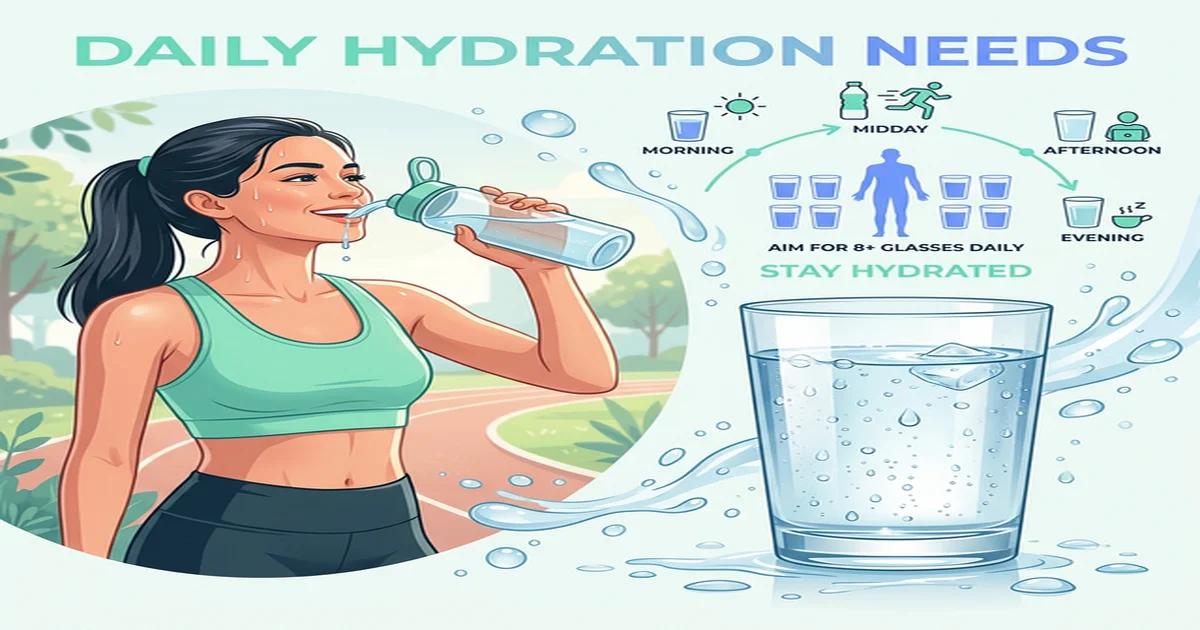
Knowing your target is one thing; actually hitting it every day is another. Here are evidence-backed strategies that work.
- Start the morning with a full glass of water before coffee or breakfast. Overnight fasting leaves you mildly dehydrated.
- Carry a reusable bottle with volume markings so you can track intake without guessing.
- Set time-based reminders on your phone, splitting your daily target across waking hours.
- Flavor water naturally with lemon, cucumber, mint, or berries if you find plain water boring.
- Eat water-rich foods: cucumber (96% water), lettuce (95%), watermelon (92%), strawberries (91%), oranges (87%), and yogurt (85%) all contribute significantly.
- Drink a glass of water before each meal. A 2015 study in Obesity found that this simple habit led to an average of 1.3 kg more weight loss over 12 weeks.
- Match every cup of coffee or alcohol with an equal cup of water to offset the mild diuretic effect.
- Keep a glass on your desk as a visual cue. Behavioral research shows that proximity and visibility increase consumption.
Does coffee count?
Yes. Despite its reputation as a diuretic, moderate coffee consumption (up to about 400 mg of caffeine per day, or roughly 4 cups) contributes to net hydration. A 2014 study published in PLOS ONE found no significant difference in hydration markers between subjects who drank coffee and those who drank equal amounts of water. The diuretic effect of caffeine is mild and does not offset the fluid provided by the beverage itself.
How our water intake calculator personalizes your target
Generic guidelines are useful starting points, but a personalized recommendation is far more actionable. Our water intake calculator factors in your body weight, activity level, climate, and life stage (pregnancy, breastfeeding) to generate a daily target tailored to you.
It starts from a baseline of 33 mL per kilogram, the middle of the 30-35 mL range used in clinical hydration guidelines and consistent with the Popkin review. It then adds about 350 mL for light activity, 700 mL for moderate activity, or 1,000 mL for intense daily exercise or physical labor; 500 mL for a hot climate; and the EFSA increments of 300 mL in pregnancy or 700 mL while breastfeeding. Finally, it subtracts the ~20% that typically comes from food, so you see both your total water and the amount to drink, in liters and in 250 mL glasses.
Example calculation
A 70 kg moderately active man in a temperate climate: Base = 70 x 33 mL = 2,310 mL (2.31 L). Activity adjustment = +700 mL. Total = 3.01 L per day, or about 12 glasses (250 mL each). After subtracting ~20% from food, that is about 2.4 L to drink.
Try it now and discover your personalized daily water target. Pair the result with the monitoring tips above, and you will know not only how much to drink but also how to tell whether you are staying on track.
Staying hydrated does not require obsessive tracking or expensive supplements. Understand your baseline, adjust for the variables in your life, listen to your body, and use tools like our water intake calculator to put science-backed numbers behind your daily habits.
Sources
- Institute of Medicine. Dietary Reference Intakes for Water, Potassium, Sodium, Chloride, and Sulfate. Washington, DC: The National Academies Press; 2004.
- EFSA Panel on Dietetic Products, Nutrition and Allergies. Scientific Opinion on Dietary Reference Values for water. EFSA Journal. 2010;8(3):1459.
- Popkin BM, D'Anci KE, Rosenberg IH. Water, hydration, and health. Nutr Rev. 2010;68(8):439-458.
- Sawka MN, Burke LM, Eichner ER, Maughan RJ, Montain SJ, Stachenfeld NS. American College of Sports Medicine position stand. Exercise and fluid replacement. Med Sci Sports Exerc. 2007;39(2):377-390.
- Kenefick RW, Cheuvront SN. Hydration for recreational sport and physical activity. Nutrition Reviews. 2012;70(Suppl 2):S137-42.