Cardiology
AFib Stroke vs Bleeding Risk: CHA₂DS₂-VASc & HAS-BLED
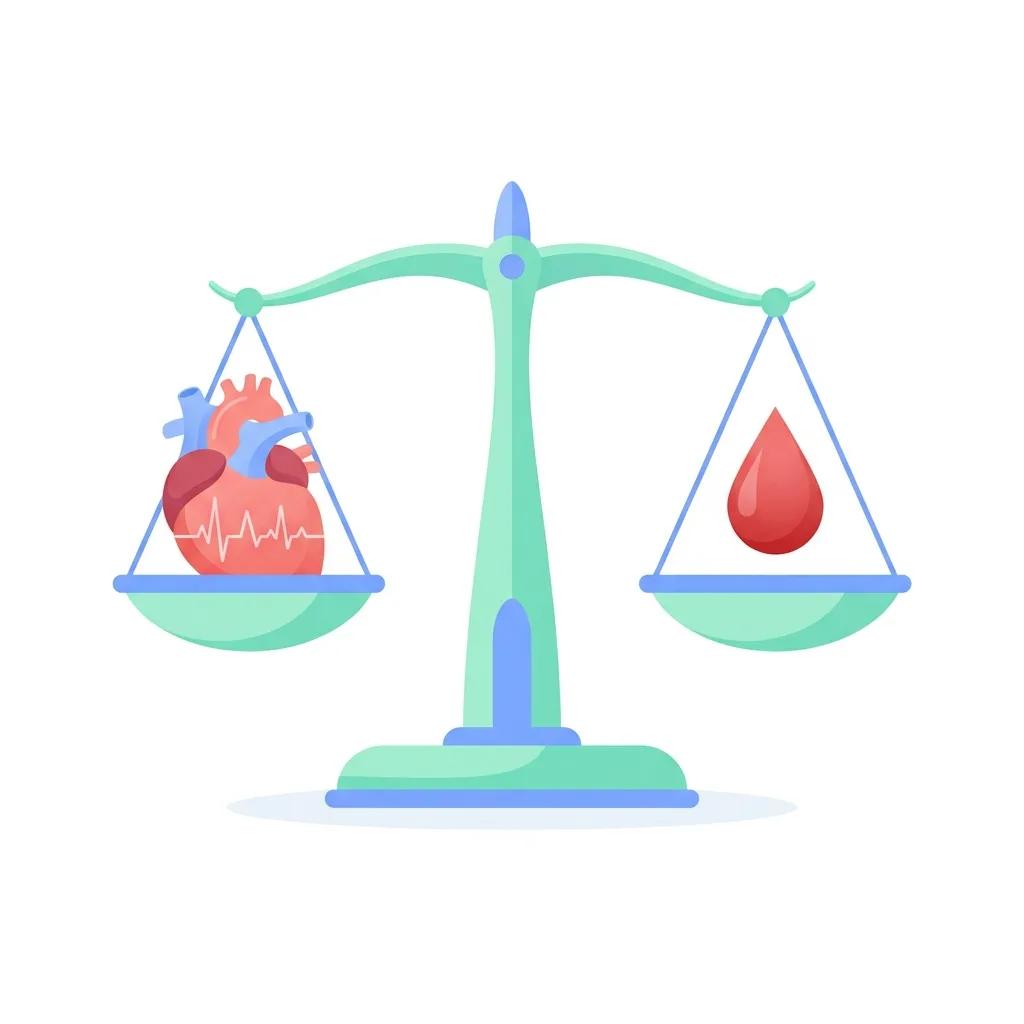
In atrial fibrillation, the same blood thinner that prevents a stroke can also cause a bleed. Two scores — CHA₂DS₂-VASc and HAS-BLED — put both sides of that decision into numbers.

Free online tool
CHA₂DS₂-VASc (stroke risk)
If you have atrial fibrillation, the central treatment question is not simply “do I need a blood thinner?” — it is a balance. The same anticoagulation that prevents a devastating stroke also raises the chance of serious bleeding. Two validated scoring systems put each side of that balance into a number: CHA₂DS₂-VASc estimates stroke risk, and HAS-BLED estimates bleeding risk. This article explains what each measures, how they are scored, and — most importantly — how a clinician weighs them together.
Why atrial fibrillation raises stroke risk
Atrial fibrillation (AFib) is an irregular, often rapid heart rhythm in which the upper chambers of the heart (the atria) quiver instead of contracting in a coordinated way. Because the atria no longer empty effectively, blood can pool — particularly in a small pouch called the left atrial appendage.
Stagnant blood tends to clot. If a clot forms in the heart and then breaks loose, it can travel to the brain and block an artery, causing an ischaemic stroke. This is why people with AFib have a substantially higher stroke risk than people in normal rhythm, and why preventing clot formation — with oral anticoagulation — is the cornerstone of AFib stroke prevention.
CHA₂DS₂-VASc: scoring stroke risk
CHA₂DS₂-VASc estimates the annual risk of stroke or systemic embolism in a person with non-valvular AFib. It was introduced by Lip and colleagues in 2010 and later validated in very large populations, including the Swedish Atrial Fibrillation cohort of over 182,000 patients (Friberg 2012). The score ranges from 0 to 9; each risk factor adds points as follows:
How the CHA₂DS₂-VASc points add up (0–9)
C — Congestive heart failure (1 point)
A history of heart failure or moderate-to-severe left ventricular dysfunction.
H — Hypertension (1 point)
A history of high blood pressure, treated or untreated.
A — Age (1 or 2 points)
Age 65–74 adds 1 point; age 75 or older adds 2 points. Age is one of the strongest drivers of the score.
D — Diabetes (1 point)
A diagnosis of diabetes mellitus.
S₂ — Prior stroke / TIA / thromboembolism (2 points)
A previous stroke, transient ischaemic attack, or systemic embolism — the heaviest single item, worth 2 points.
V — Vascular disease (1 point)
Prior myocardial infarction, peripheral artery disease, or aortic plaque.
Sc — Sex category, female (1 point)
Female sex adds 1 point, generally counted as a risk modifier rather than a standalone reason to treat. The 2024 ESC guideline drops it altogether and uses CHA₂DS₂-VA.
The higher the CHA₂DS₂-VASc score, the higher the estimated annual stroke risk — which is what tips the balance toward recommending anticoagulation. You can work out your own score with our calculator.
Open the CHA₂DS₂-VASc calculator →HAS-BLED: scoring bleeding risk
HAS-BLED estimates the 1-year risk of major bleeding in a person with AFib who is taking (or being considered for) anticoagulation. It was derived by Pisters and colleagues in 2010 from the Euro Heart Survey. The score also ranges from 0 to 9, with one point for each of the following:
The HAS-BLED components (1 point each, 0–9)
- H — Uncontrolled hypertension (high systolic blood pressure).
- A — Abnormal renal function (e.g. dialysis, transplant, or markedly elevated creatinine).
- A — Abnormal liver function (chronic liver disease or significant biochemical derangement).
- S — Prior stroke.
- B — Prior major bleeding or a predisposition to bleeding (e.g. anaemia).
- L — Labile INR (unstable or out-of-range INR values on warfarin).
- E — Elderly, age over 65.
- D — Drugs that promote bleeding (antiplatelet agents or NSAIDs).
- D — Alcohol intake of 8 or more units per week.
A higher HAS-BLED score signals a higher bleeding risk and the need for closer follow-up — not automatically a reason to withhold anticoagulation. You can estimate your own bleeding risk with our calculator.
Open the HAS-BLED calculator →How the two scores are weighed together
This is the core message. CHA₂DS₂-VASc and HAS-BLED are not a tug-of-war where the bigger number wins. The 2020 ESC Guidelines for atrial fibrillation (Hindricks 2021) are explicit: a high HAS-BLED score does NOT contraindicate anticoagulation. Instead, it flags the modifiable factors that should be corrected and the patients who need more careful monitoring.
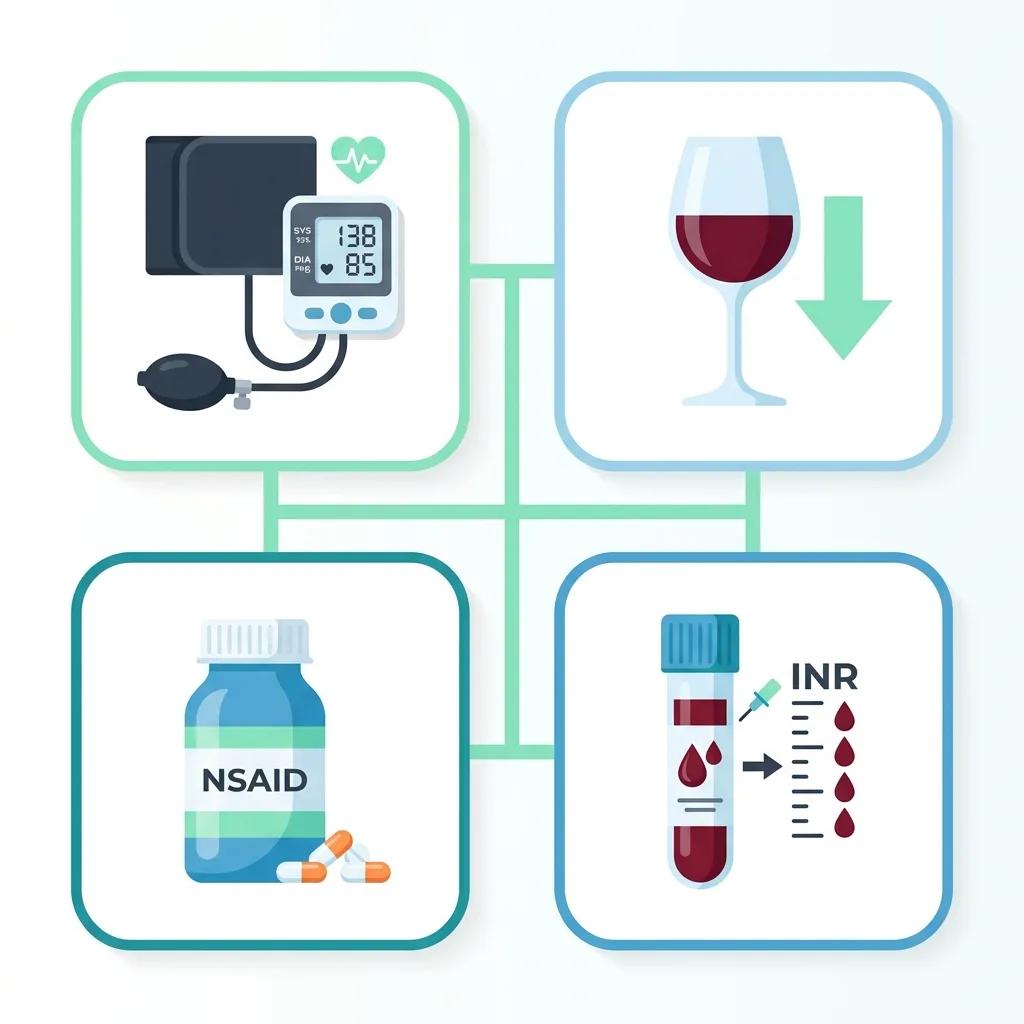
Several HAS-BLED items are modifiable: uncontrolled blood pressure can be treated, labile INR can be stabilised (or warfarin swapped for a direct oral anticoagulant), unnecessary antiplatelet drugs and NSAIDs can be stopped, and alcohol intake can be reduced. Correcting these lowers bleeding risk while the patient stays protected against stroke. In practice, clinicians use CHA₂DS₂-VASc to decide whether anticoagulation is warranted, then use HAS-BLED to identify and fix what makes bleeding more likely.
The benefit side: how much anticoagulation helps
The reason this balance usually tips toward treatment is the sheer size of the stroke-prevention benefit. A landmark meta-analysis by Hart and colleagues (2007) found that oral anticoagulation reduces stroke by roughly 64% compared with no antithrombotic therapy in non-valvular AFib. The 2020 ESC Guidelines now generally prefer direct oral anticoagulants (DOACs) over warfarin for most patients, because they offer comparable or better protection with a more predictable safety profile and no routine INR monitoring.
The headline numbers
Stroke reduction with anticoagulation
≈64% vs no antithrombotic therapy (Hart 2007)
CHA₂DS₂-VASc range
0–9 — higher = higher annual stroke risk
HAS-BLED range
0–9 — higher = higher major-bleeding risk
Bottom line
CHA₂DS₂-VASc and HAS-BLED are complementary, not competing. The first quantifies the stroke you are trying to prevent; the second quantifies the bleeding you are trying to avoid and — crucially — highlights which risks can be reduced. For most people with meaningful stroke risk, the benefit of anticoagulation outweighs the bleeding risk, especially once modifiable factors are addressed. Run both calculators to see your own numbers, then bring them to your doctor.
This article is for education only and is not medical advice. CHA₂DS₂-VASc and HAS-BLED are screening tools, not a substitute for clinical judgement. The decision to start, change, or stop anticoagulation is individualised and must be made by a qualified physician who knows your full medical history.
Sources
- Lip GYH et al. (2010). Refining clinical risk stratification for predicting stroke and thromboembolism in atrial fibrillation using a novel risk factor-based approach: the Euro Heart Survey on Atrial Fibrillation. Chest 137(2):263-272.
- Pisters R et al. (2010). A novel user-friendly score (HAS-BLED) to assess 1-year risk of major bleeding in patients with atrial fibrillation: the Euro Heart Survey. Chest 138(5):1093-1100.
- Friberg L et al. (2012). Evaluation of risk stratification schemes for ischaemic stroke and bleeding in 182 678 patients with atrial fibrillation: the Swedish Atrial Fibrillation cohort study. Eur Heart J 33(12):1500-1510.
- Hindricks G et al. (2021). 2020 ESC Guidelines for the diagnosis and management of atrial fibrillation. Eur Heart J 42(5):373-498.
- Hart RG et al. (2007). Meta-analysis: antithrombotic therapy to prevent stroke in patients who have nonvalvular atrial fibrillation. Ann Intern Med 146(12):857-867.
- Van Gelder IC et al. (2024). 2024 ESC Guidelines for the management of atrial fibrillation. Eur Heart J 45(36):3314-3414.