
Ovulation Calculator: Find Your Most Fertile Days
Calculate your ovulation date and fertile window based on your last period and cycle length. Predict your next 3 cycles with our free ovulation calendar.
CalcVita. (2026). Ovulation Calculator: Find Your Most Fertile Days. CalcVita. Retrieved October 16, 2026, from https://calcvita.com/en/calculators/ovulation
Suggested article
Understanding Your Fertile Window: The Science Behind Ovulation Tracking
Work out your fertile days and ovulation date from your cycle length, then sharpen the estimate with cervical mucus, basal temperature and LH tests. Backed by peer-reviewed research.
Read the full article →How does this calculator work?
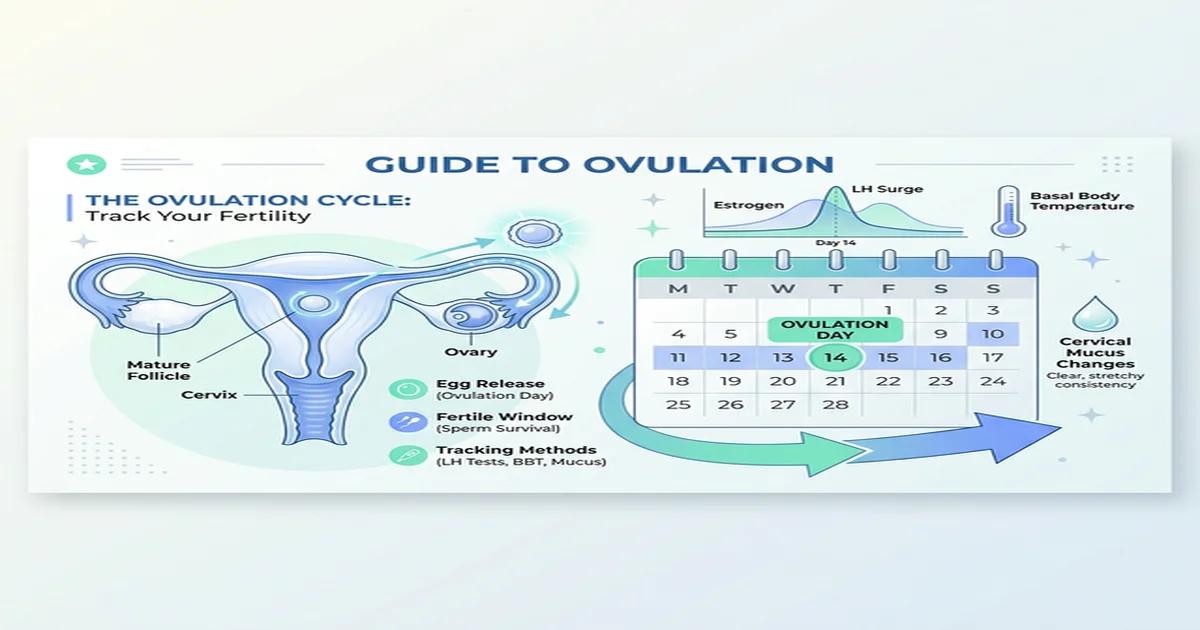
This ovulation calculator uses the calendar method: it places ovulation 14 days before the next expected period (cycle length minus 14) and marks the fertile window as the 5 days before ovulation plus ovulation day itself. That window comes from Wilcox et al. (NEJM 1995): nearly all pregnancies followed intercourse within those six days, because sperm can survive up to 5 days in the reproductive tract while the egg remains viable for only 12-24 hours. The luteal phase is less fixed than the formula assumes (12.4 days on average in more than 600,000 cycles, Bull et al. 2019), so the date is an estimate.
Understanding the fertile window
In Wilcox et al. (1995) the probability of conception rose from 10% when intercourse took place five days before ovulation to 33% on the day of ovulation, and nearly all pregnancies came from that six-day window; Dunson et al. (2002), with 782 couples, confirmed the 6-day window at every age. This calculator highlights those days to help you plan.
Limitations and when to see a doctor
The calendar method assumes regular cycles. If your cycles vary by more than 7 days, results will be less accurate (Fehring et al., 2006). Stress, illness, travel, PCOS, thyroid disorders, and medication can shift ovulation timing. If you have been trying to conceive for 12+ months (or 6+ months if over 35), consult a fertility specialist. This tool is NOT a contraceptive method.
Scientific Sources
- Wilcox AJ et al. (1995) — Timing of sexual intercourse in relation to ovulation. NEJM. PMID 7477165
- Dunson DB et al. (2002) — Changes with age in the level and duration of fertility in the menstrual cycle. Human Reproduction. PMID 11980771
- Fehring RJ et al. (2006) — Variability in the phases of the menstrual cycle. JOGNN. PMID 16700687
- Bull JR et al. (2019) — Real-world menstrual cycle characteristics of more than 600,000 cycles. NPJ Digital Medicine. 2:83
- ACOG — Fertility Awareness-Based Methods of Family Planning (patient FAQ)
Frequently asked questions
- How accurate is the calendar method for predicting ovulation?
- The calendar method assumes that ovulation happens about 14 days before the next period, so it estimates it at cycle length minus 14 days. It works best with regular cycles. In practice the variation is large: in Bull et al. (2019), an analysis of more than 600,000 cycles, only 13% of cycles lasted exactly 28 days and the luteal phase averaged 12.4 days rather than 14, so results are estimates. For greater precision, combine it with basal body temperature or ovulation test kits.
- How long is the fertile window?
- About 6 days: the 5 days before ovulation plus ovulation day itself. In Wilcox et al. (1995), which followed 221 women trying to conceive, nearly all pregnancies came from intercourse within that window; the probability of conception rose from 10% five days before ovulation to 33% on the day of ovulation. Dunson et al. (2002), with 782 couples, found the same 6-day window at every age. Sperm can survive up to 5 days in the reproductive tract, while the egg remains viable for only 12-24 hours.
- Can I use this calculator as a contraceptive method?
- No. The calendar method alone is not reliable enough for contraception, especially with irregular cycles. ACOG states that fertility awareness-based methods have a typical-use failure rate of 12-24%. This calculator is designed as a conception planning aid, not a contraceptive tool. Consult your healthcare provider for contraception advice.
- What affects cycle length and ovulation timing?
- Cycle length can change with stress, illness, travel, weight changes, intense exercise and hormonal conditions such as PCOS or thyroid disorders. Even in healthy women with regular cycles the variation is large: in Fehring et al. (2006), 42.5% of women had cycles that varied by more than 7 days, and most of that variability came from the follicular phase (before ovulation); the luteal phase (after ovulation) is more stable.
More calculators