First trimester
Ultrasound Pregnancy Dating: CRL, Gestational Age, and How Your Due Date is Calculated
How does a dating scan turn a CRL measurement or gestational age into an estimated due date? This guide explains the Robinson & Fleming formula, ACOG dating guidelines, and how to read your pregnancy milestones.
Free online tool
Due date by ultrasound
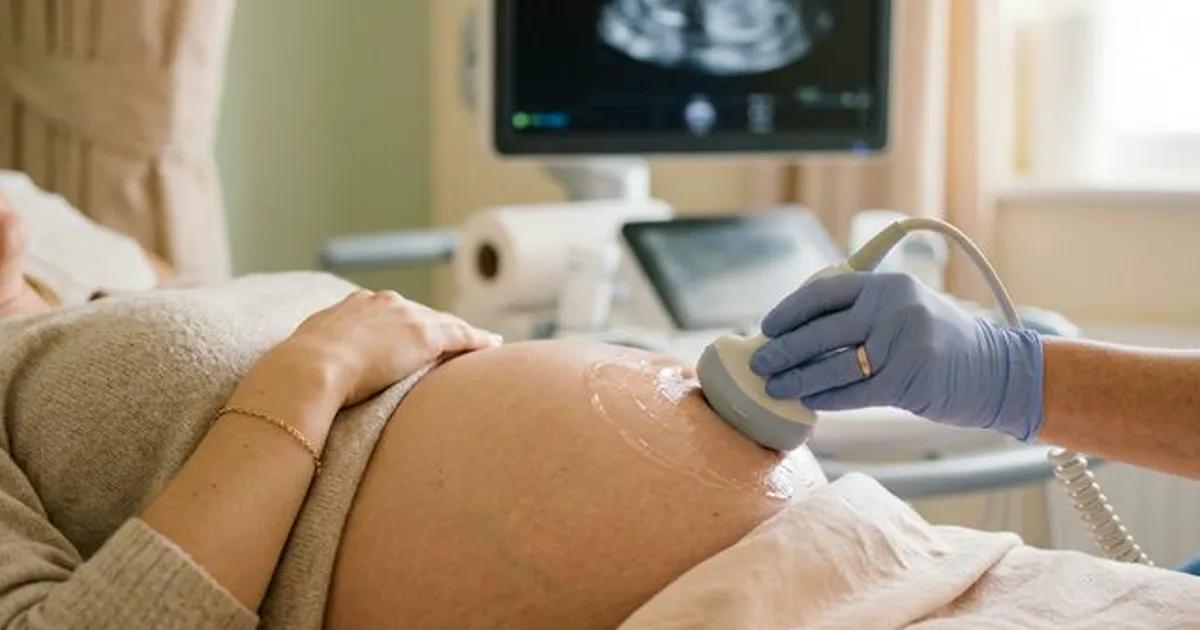
An ultrasound dating scan is the most accurate method for establishing a pregnancy's estimated due date (EDD). Unlike menstrual dating — which assumes a regular 28-day cycle with ovulation on day 14 — ultrasound directly measures fetal size, removing the uncertainty of irregular cycles, late ovulation, or an unknown last menstrual period (LMP).
Why Ultrasound Dating Is More Accurate Than Menstrual Dating
ACOG Committee Opinion 700 (2017), endorsed by AIUM and SMFM, recommends using ultrasound dating as the reference whenever there is a meaningful discrepancy between LMP-based and ultrasound-based EDD estimates. The thresholds are: 5 days before 9+0 weeks, 7 days at 9+0–13+6 weeks, 7 days at 14–15+6 weeks, 10 days at 16–21+6 weeks, 14 days at 22–27+6 weeks, and 21 days at ≥28 weeks. If the discrepancy is smaller than the threshold, the LMP-based date is retained; if it is larger, the ultrasound date replaces it.
Key principle
The earlier in pregnancy the dating scan is performed, the more accurate it is. First-trimester CRL dating is accurate to ±5–7 days (95% CI). By the third trimester, biometry accuracy falls to ±3–4 weeks.
Crown-Rump Length (CRL) Dating
Between approximately 6 and 14 weeks of gestation (CRL 10–84 mm), the crown-rump length is the gold-standard measurement for establishing gestational age. CRL is the longest straight-line dimension of the embryo or fetus, measured from the top of the head (crown) to the bottom of the torso (rump). It does not include the legs.
Robinson & Fleming (1975) described the relationship between CRL and gestational age with the equation GA (days) = 8.052 × √CRL (mm) + 23.73. Our calculator applies this equation, rounded to the nearest day: a CRL of 45 mm corresponds to 11 weeks 1 day, and 84 mm to 14 weeks 0 days.
CRL reference values (Robinson & Fleming 1975)
CRL 10 mm
~7w0d
Early first trimester; crown-rump length just above the minimum for reliable measurement.
CRL 25 mm
~9w1d
EDD = scan date + 216 days.
CRL 45 mm
~11w1d
Ideal window for combined first-trimester screening (NT measurement at 11–13+6w).
CRL 65 mm
~12w5d
Upper range of first-trimester dating; NT measurement still valid.
CRL 84 mm
~14w0d
Upper limit of the validated CRL formula range.
Gestational Age (GA) Input Mode
If your ultrasound report already provides the gestational age in weeks and days (for example, '12 weeks 3 days'), you can enter that directly. The calculator applies the standard ACOG formula: EDD = scan date + (280 − GA at scan in days). For a 12w3d scan, that is 280 − 87 = 193 additional days from the scan date.
LMP-Equivalent and Pregnancy Milestones
Once the EDD is established, the calculator derives an LMP-equivalent by subtracting 280 days (EDD − 280 days). This LMP-equivalent is a useful administrative reference: it is used to calculate all standard pregnancy milestones relative to a conventional start point, even when the actual LMP is unknown or unreliable. All milestone dates shown by the calculator are offsets from this LMP-equivalent.
Key pregnancy milestones
Conception
~2w0d
Approximately 14 days after LMP, corresponding to ovulation in a 28-day cycle.
End of 1st trimester
14w0d
Traditional end of first trimester; miscarriage risk falls sharply after this point.
Anatomy scan
20w0d
Mid-pregnancy structural survey (anomaly scan). Fetal organs and anatomy are evaluated.
Start of 3rd trimester
28w0d
Viability threshold well-established; third-trimester monitoring begins.
Term
37w0d
Early term. Deliveries at 37–38+6w have slightly higher neonatal morbidity than full term (39–40+6w).
Due date (EDD)
40w0d
The estimated due date. Only about 5% of babies are born on their exact EDD.
Post-term
42w0d
ACOG and NICE recommend induction of labour by 42 weeks to reduce stillbirth risk.
Accuracy by Trimester: What ±5 Days Really Means
Ultrasound dating loses precision as pregnancy advances. In the first trimester, CRL has the tightest 95% confidence interval because every embryo follows the same growth velocity until about 14 weeks. From the second trimester onward, individual genetic potential, placental function, and maternal factors begin to introduce real biological variability — a perfectly healthy fetus can be a week ahead or behind the population mean. By the third trimester, dating from biometry is so wide that ACOG explicitly states it should never replace earlier dating estimates.
Accuracy of ultrasound dating (ACOG 2017)
≤ 8+6 weeks (CRL)
± 5–7 days
Tightest accuracy window. The dating scan during this period replaces LMP whenever the discrepancy exceeds 5 days.
9+0 – 13+6 weeks (CRL)
± 5 – 7 days
Still gold standard. Combined with NT measurement, this is the recommended dating window for routine first-trimester care.
14+0 – 15+6 weeks (BPD/HC)
± 7–10 days
CRL no longer reliable above ~84 mm; biparietal diameter and head circumference become the dating measurements.
16+0 – 21+6 weeks
± 7–10 days
Anatomy-scan era. Dating is still reasonable, but less precise than in the first trimester.
22+0 – 27+6 weeks
± 10–14 days
Use only when no earlier scan is available; a two-week uncertainty is now routine.
≥ 28+0 weeks
± 21–30 days
Very wide CI. Pregnancies first dated this late are considered 'suboptimally dated' by ACOG.
Second-Trimester Biometry: BPD, HC, AC, FL
Once CRL becomes unreliable, sonographers shift to four biometric measurements. Biparietal diameter (BPD) is the transverse outer-to-inner skull diameter at the level of the thalami. Head circumference (HC) traces the perimeter of the skull at the same plane. Abdominal circumference (AC) is measured at the level of the stomach bubble and umbilical-portal vein junction. Femur length (FL) measures the diaphyseal shaft. Hadlock and colleagues established the most widely used dating curves for these measures in the early 1980s (PMID 6978026 for HC), and they are still built into most obstetric ultrasound machines.
After 14 weeks, ACOG recommends dating from a combination of measurements rather than a single one: the machine applies regression formulas that combine BPD, HC, AC and FL (Hadlock et al., 1984). Combining them reduces the weight of any single atypical measurement — for example, a constitutionally short femur in a healthy fetus shifts the estimate much less than if the femur were used alone.
When the Sonographer 'Re-dates' Your Pregnancy
If the ultrasound EDD differs from the LMP-derived EDD by more than the trimester-specific threshold, ACOG Committee Opinion 700 (PMID 28426621) and ISUOG (Salomon et al. 2013, PMID 23280739) recommend that the ultrasound EDD becomes the official dating standard for the rest of pregnancy. Once an EDD is established, it should not be changed by subsequent scans — this is the 'first-dating-prevails' principle. Changing the EDD later in pregnancy can produce paradoxes such as a fetus that appears growth-restricted only because the gestational reference moved.
Why the threshold matters
The wider the threshold, the more weight is given to LMP. The narrow 5-day T1 threshold reflects the very low biological variability of early embryonic growth. Outside that window, growth velocity differences between individual fetuses can produce a real ultrasound-LMP gap that does not represent a wrong LMP.
Limitations and Sources of Error
- Operator-dependent: CRL accuracy depends on a mid-sagittal section with the embryo in neutral flexion — incorrect angles overestimate or underestimate by several days.
- IVF pregnancies should be dated from embryo transfer, not from CRL, because the conception date is known precisely.
- Multiple pregnancies are dated from the larger embryo in the first trimester; later in pregnancy, the larger head circumference is generally used.
- Maternal obesity reduces image quality and may widen the practical CI beyond the population values shown above.
- Population-derived dating curves (Robinson & Fleming, Hadlock, Verburg) were built on predominantly European and North American cohorts; minor recalibration may apply in other populations.
Action Plan by Gestational Age at First Scan
What to do once you have a dating scan
Scan before 14 weeks
Your EDD is set with maximum confidence. Use the LMP-equivalent date the calculator derives to schedule all subsequent milestones, and do not revise the EDD even if the 20-week scan suggests a slightly different size.
Scan between 14 and 22 weeks
Still acceptable as primary dating, but the CI widens to 7–10 days. If your LMP is reliable and within the threshold, your provider may stay with the LMP-based EDD.
Scan after 22 weeks
ACOG considers this a 'suboptimally dated' pregnancy. Decisions about post-term induction, growth restriction, and corticosteroid timing must be interpreted with the wide CI in mind. Discuss explicitly with your obstetrician.
Discuss your results with your clinician
Pregnancy dating drives every subsequent decision — screening windows, viability assessment, induction timing — so any uncertainty in your EDD should be reviewed with your obstetrician or midwife. Online calculators replicate the standard formulas but do not replace clinical interpretation of the actual scan images.
Use the CalcVita Ultrasound Dating calculator to convert a CRL measurement or the gestational age reported on the day of the scan into your EDD and full pregnancy milestone timeline.
Sources
- Robinson HP, Fleming JE (1975). A critical evaluation of sonar crown-rump length measurements. Br J Obstet Gynaecol 82(9):702-710. PMID 1182090.
- ACOG Committee Opinion No. 700 (2017). Methods for Estimating the Due Date. Obstet Gynecol 129(5):e150-e154. PMID 28426621.
- Salomon LJ et al.; ISUOG (2013). ISUOG practice guidelines: performance of first-trimester fetal ultrasound scan. Ultrasound Obstet Gynecol 41(1):102-113. PMID 23280739.
- Salomon LJ et al.; ISUOG (2022). ISUOG Practice Guidelines (updated): performance of the routine mid-trimester fetal ultrasound scan. Ultrasound Obstet Gynecol 59(6):840-856. PMID 35592929.
- Verburg BO et al. (2008). New charts for ultrasound dating of pregnancy and assessment of fetal growth: longitudinal data from a population-based cohort study. Ultrasound Obstet Gynecol 31(4):388-396. PMID 18348183.
- Hadlock FP, Deter RL, Harrist RB, Park SK (1982). Fetal head circumference: relation to menstrual age. AJR Am J Roentgenol 138(4):649-653. PMID 6978026.