Calorie planning
Total Daily Energy Expenditure without guesswork
Calculate your maintenance calories (TDEE) and use that baseline to design a safe calorie deficit for weight loss.

Free online tool
TDEE calculator
What is TDEE?
Total Daily Energy Expenditure (TDEE) is the total number of calories your body burns in a 24-hour period. It represents the sum of all metabolic processes, from keeping your heart beating and lungs breathing to digesting food and walking up stairs. Understanding your TDEE is the foundation of any evidence-based nutrition plan because it tells you how much energy you need to maintain your current weight.
Without knowing your TDEE, any calorie target is a guess. Eating too little leads to muscle loss, nutrient deficiencies, and metabolic adaptation. Eating too much leads to unwanted fat gain. TDEE gives you a personalized baseline around which you can make controlled, sustainable adjustments.
The three components of TDEE
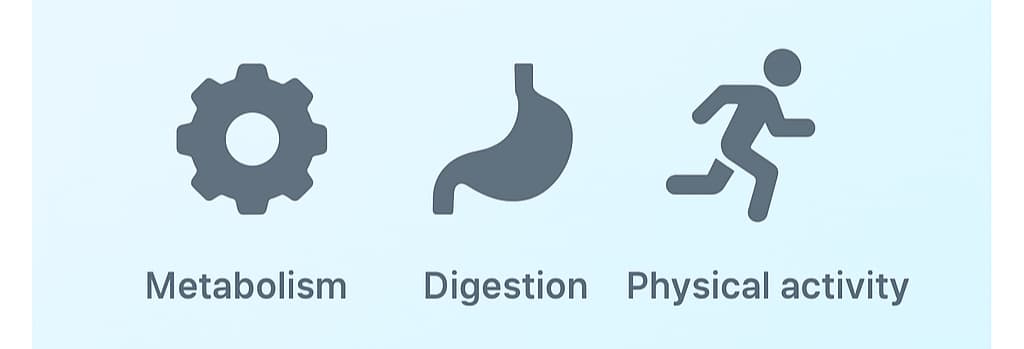
Energy expenditure breakdown
60-70%
Basal Metabolic Rate (BMR)
The energy your body needs at complete rest to maintain vital functions: breathing, circulation, cell production, and temperature regulation. BMR is influenced by age, sex, weight, height, and lean mass. It is the largest component of TDEE for most people.
~10%
Thermic Effect of Food (TEF)
The energy cost of digesting, absorbing, and metabolizing food. Protein has the highest TEF (20-30% of its calories are used during digestion), followed by carbohydrates (5-10%) and fat (0-3%). This is one reason high-protein diets have a slight metabolic advantage.
15-30%
Physical Activity (EAT + NEAT)
Exercise Activity Thermogenesis (EAT) is the calories burned during structured workouts. Non-Exercise Activity Thermogenesis (NEAT) includes all other movement: walking, fidgeting, standing, household chores, and occupational activity. NEAT is highly variable between individuals and can differ by up to 2,000 calories per day.
How TDEE is calculated
The most common approach is to estimate your BMR using a validated equation and then multiply it by an activity factor. Our calculator uses the Mifflin-St Jeor equation; these are the three most established options:
- Mifflin-St Jeor equation (1990): Considered the most accurate for the general population. It uses weight, height, age, and sex. A 2005 review by the American Dietetic Association confirmed it predicts BMR within 10% of measured values in about 82% of people.
- Harris-Benedict equation (1919, revised 1984): One of the oldest and most widely known formulas. Slightly less accurate than Mifflin-St Jeor but still commonly used.
- Katch-McArdle equation: Uses lean body mass instead of total weight, making it more accurate for people who know their body fat percentage, especially athletes or very lean individuals.
After calculating BMR, the tool multiplies it by an activity factor. Standard multipliers range from 1.2 (sedentary) to 1.9 (extremely active). Selecting the right activity level is the most common source of error in TDEE estimation. Most people overestimate their activity level. If unsure, start with a lower multiplier and adjust based on real-world results.
Using the TDEE calculator
- Enter your age, sex, current weight, and height.
- Select the activity level that best matches a typical week. Be honest. Three gym sessions per week with a desk job is 'lightly active,' not 'very active.'
- Review the three targets the calculator shows: maintenance (your TDEE), weight loss (TDEE minus 500 calories) and weight gain (TDEE plus 300 calories).
- Record the suggested calorie target and use it as a starting point for 2-3 weeks.
- Compare your actual weight trend to the prediction. If weight is not changing as expected, adjust calories by 10-15% in the appropriate direction.
Setting up a calorie deficit for fat loss
A calorie deficit means eating fewer calories than your TDEE so your body draws on stored energy (primarily fat) to make up the difference. The size of the deficit determines how fast you lose weight and how sustainable the process is.
Deficit guidelines
250 cal/day
~0.25 kg/week loss
A conservative deficit suitable for people close to their goal weight or those who want minimal impact on training performance.
500 cal/day
~0.5 kg/week loss
The classic moderate deficit. Sustainable for most people and large enough to produce visible results within weeks.
750-1000 cal/day
~0.75-1 kg/week loss
Aggressive but sometimes appropriate for individuals with significant weight to lose. Should be supervised and time-limited to avoid excessive muscle loss and metabolic adaptation.
Slow beats extreme
Aggressive deficits are hard to sustain and increase the risk of muscle loss, micronutrient deficiencies, hormonal disruption, and binge-restrict cycles. In a 2011 trial in elite athletes (Garthe et al.), those who lost about 0.7% of body weight per week while strength training gained lean mass, whereas the group assigned to a faster rate (1.4% per week) did not.
Setting up a calorie surplus for muscle gain
To build muscle efficiently, you need a modest calorie surplus combined with resistance training and adequate protein. A surplus of 200-300 calories per day is sufficient for most people to support muscle gain without excessive fat gain. A 2019 review on natural bodybuilders (Iraki et al.) suggests a surplus of about 10-20% above maintenance, aiming to gain 0.25-0.5% of body weight per week, and a more conservative surplus for advanced lifters.
Protein intake during a surplus should remain at 1.6-2.2 g/kg/day. The extra calories should come primarily from carbohydrates, which fuel training and replenish muscle glycogen, with modest increases in fat to support hormonal function.
Why your TDEE changes over time
TDEE is not a fixed number. It shifts in response to multiple factors:
- Weight loss: As you lose weight, your BMR decreases because there is less tissue to maintain. For every kilogram of weight lost, daily energy expenditure drops by roughly 20-30 calories.
- Metabolic adaptation: During prolonged deficits, the body becomes more energy-efficient, reducing NEAT and slightly lowering BMR beyond what weight loss alone would predict. This is sometimes called 'adaptive thermogenesis.'
- Muscle gain: Gaining lean mass slightly increases BMR (about 13 calories per kilogram of muscle per day) and can increase NEAT and workout performance.
- Aging: adjusted for body size and composition, energy expenditure stays remarkably stable from about age 20 to 60 and declines after 60 (Pontzer et al., Science 2021). Before then, most of the drop people notice comes from losing muscle and moving less.
- Hormonal changes: Menstrual cycle, thyroid function, stress hormones, and sleep all modulate daily energy expenditure.
Interpreting the output and adjusting
Think of the calculator's output as a starting estimate, not a final prescription. Stress, hormones, sleep quality, changes in muscle mass, and even the accuracy of your food logging can all shift real-world results by a few hundred calories.
- Weigh yourself daily at the same time (morning, post-bathroom, pre-food) and track the weekly average.
- If the weekly average is not moving in the expected direction after 2-3 weeks of consistent adherence, adjust calories by 100-200 in the appropriate direction.
- Monitor performance in the gym, energy levels, sleep quality, and hunger. These qualitative signals are just as important as the scale.
- Reassess your full TDEE every 4-8 weeks or after a significant change in weight, activity, or lifestyle.
Practical next steps
- Anchor meals around protein and vegetables to improve satiety and nutrient density.
- Prioritize resistance training and daily steps to raise NEAT and protect lean mass.
- Log weight or body measurements weekly to compare against the plan.
- If you drop more than 1% of body weight per week, the deficit is likely too large. Increase calories slightly.
- Consider a diet break (eating at maintenance for 1-2 weeks) every 8-12 weeks during prolonged fat loss phases to mitigate metabolic adaptation.
This article is for educational purposes only and does not replace professional nutritional advice. If you have a medical condition or are taking medication that affects metabolism, consult a healthcare provider before making dietary changes.
Sources
- Frankenfield D, Roth-Yousey L, Compher C (2005). Comparison of predictive equations for resting metabolic rate in healthy nonobese and obese adults: a systematic review. J Am Diet Assoc 105(5):775-789.
- Garthe I, Raastad T, Refsnes PE, et al. (2011). Effect of two different weight-loss rates on body composition and strength and power-related performance in elite athletes. Int J Sport Nutr Exerc Metab 21(2):97-104.
- Iraki J, Fitschen P, Espinar S, Helms E (2019). Nutrition Recommendations for Bodybuilders in the Off-Season: A Narrative Review. Sports (Basel) 7(7):154.
- Pontzer H, Yamada Y, Sagayama H, et al. (2021). Daily energy expenditure through the human life course. Science 373(6556):808-812.