Smart nutrition
Macro distribution for real life goals
See how many grams of protein, fat and carbohydrates you need to maintain muscle, support hormones and fuel training.
Free online tool
Macro planner
Why macronutrients matter
Calories tell you how much energy you consume, but macronutrients tell you where that energy comes from and what your body does with it. The three macronutrients, protein, fat, and carbohydrates, each serve distinct biological roles. Getting the right balance supports muscle maintenance, hormonal health, training performance, and long-term metabolic function.
The International Society of Sports Nutrition's 2017 position stand on diets and body composition (Aragon et al.) notes that a sustained calorie deficit or surplus drives weight change, while protein intake and resistance training largely determine how much of that change is fat and how much is lean mass. Two people eating the same number of calories can have very different outcomes depending on how they distribute those calories among protein, fat, and carbs.
The three macronutrients explained
Protein: the repair and preservation nutrient
Protein provides the amino acids your body needs to build and repair muscle tissue, produce enzymes and hormones, and support immune function. Each gram of protein provides 4 calories. During a calorie deficit, adequate protein intake is critical for preserving lean mass. A meta-analysis in the British Journal of Sports Medicine (Morton et al., 2018) found that the extra muscle gained with resistance training levelled off at about 1.6 g/kg/day of protein, with an upper confidence limit of about 2.2 g/kg/day.
Protein guidelines by goal
General health
0.8 g/kg/day
The minimum recommended dietary allowance (RDA) for sedentary adults. Most nutrition experts consider this inadequate for active individuals.
Fat loss
1.6-2.2 g/kg/day
Higher protein during a deficit preserves muscle, increases satiety, and raises the thermic effect of food.
Muscle gain
1.6-2.0 g/kg/day
Combined with resistance training and a slight calorie surplus, this range maximizes lean tissue accrual.
Endurance athletes
1.2-1.6 g/kg/day
Higher turnover from training volume increases protein needs beyond sedentary levels.
Fat: hormones, vitamins, and cell structure
Dietary fat is essential for absorbing fat-soluble vitamins (A, D, E, K), producing steroid hormones including testosterone and estrogen, maintaining cell membrane integrity, and providing insulation. Each gram of fat provides 9 calories, making it the most energy-dense macronutrient.
Cutting fat too low is one of the most common nutritional mistakes. A review on natural bodybuilders in the Journal of the International Society of Sports Nutrition (Helms et al., 2014) recommends keeping fat at 15-30% of calories, and a 2021 meta-analysis found that low-fat diets lower testosterone in men (Whittaker and Wu). Eating too little overall, which often goes with very low fat intakes, can also disrupt menstrual cycles. A practical floor is 0.7-1.0 g/kg of body weight per day.
Carbohydrates: the performance fuel
Carbohydrates are the body's preferred fuel source for moderate-to-high intensity exercise. They are stored as glycogen in the muscles and liver and are rapidly available during training. Each gram of carbohydrate provides 4 calories. While carbs are technically not 'essential' (the body can produce glucose through gluconeogenesis), removing them entirely can impair training performance, mood, and thyroid function.
Carbohydrate needs are the most variable of the three macros because they scale with activity level. A sedentary person may do well on 2-3 g/kg/day, while a competitive endurance athlete may need 6-10 g/kg/day. For most recreational exercisers, 3-5 g/kg/day is a reasonable range.
How to calculate your macro split
- Determine your total daily calorie target using a TDEE calculator. This is your starting budget.
- Set protein first: Multiply your body weight in kilograms by your target protein intake (e.g., 1.8 g/kg for fat loss). Multiply the result by 4 to convert to calories.
- Set fat next: Multiply your body weight by your target fat intake (e.g., 1.0 g/kg). Multiply the result by 9 to convert to calories.
- Assign the remaining calories to carbohydrates: Subtract protein and fat calories from the total, then divide by 4 to get grams of carbs.
- Translate grams into meals: Divide daily targets by the number of meals you eat to create per-meal targets that are easy to track.
Worked example
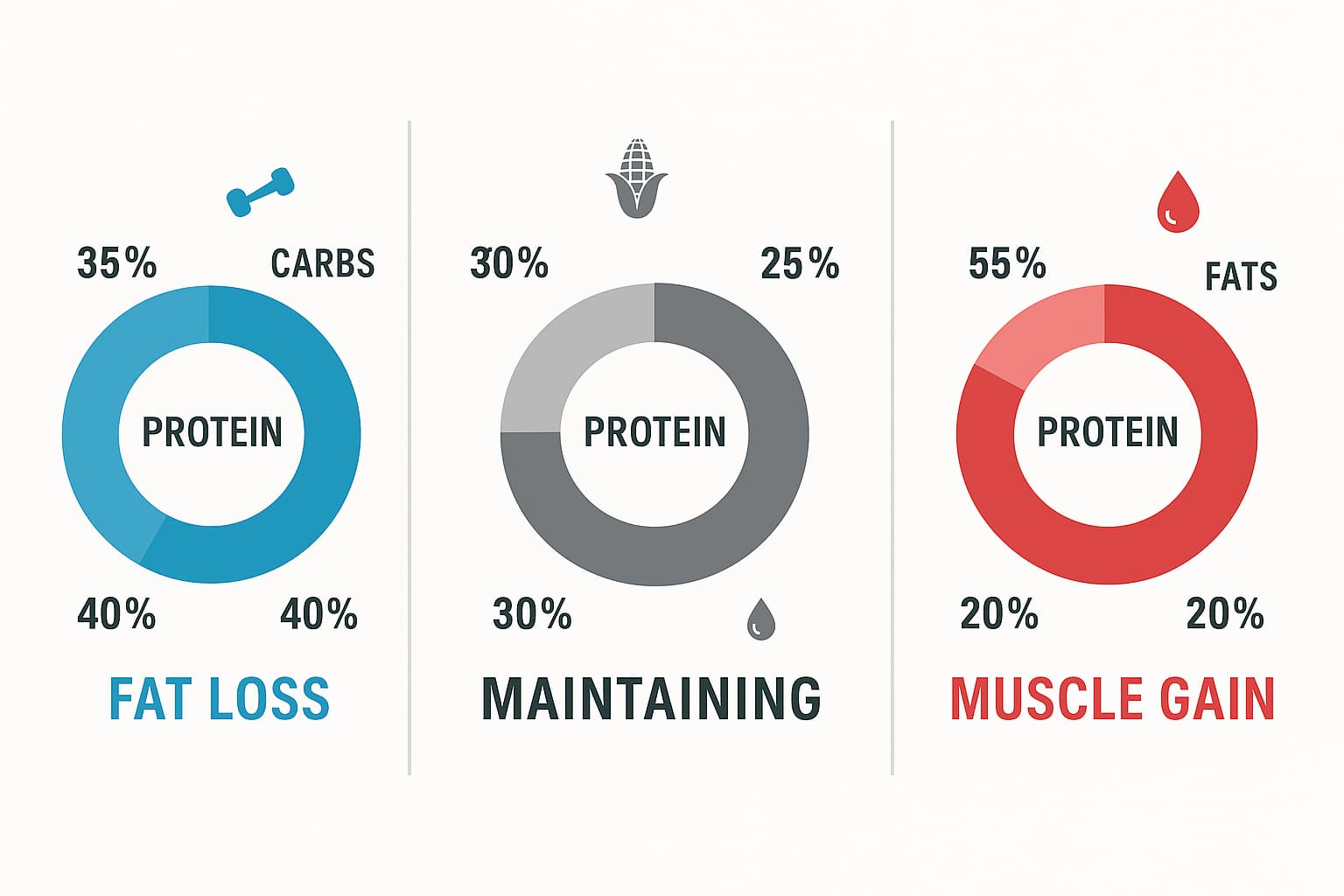
A 75 kg person targeting fat loss with a TDEE of 2,400 calories and a 500-calorie deficit (1,900 calories): Protein at 2.0 g/kg = 150 g (600 calories). Fat at 1.0 g/kg = 75 g (675 calories). Remaining for carbs: 1,900 - 600 - 675 = 625 calories, which is about 156 g of carbohydrates.
Using the macro calculator
Our calculator automates much of this process. Enter your body stats, activity level and goal (fat loss, maintenance, or muscle gain): it estimates your TDEE with the Mifflin-St Jeor equation, subtracts 500 calories for fat loss or adds 300 for muscle gain, and splits the result into grams using the ratio you choose (balanced, low-carb, high-protein, keto, or your own percentages).
- Select your goal: fat loss, maintenance, or muscle gain.
- Enter your weight, height, age, and sex for accurate baseline calculations.
- Set your activity level, which scales your estimated calorie needs.
- Choose a ratio and review the daily gram targets for protein, fat, and carbohydrates. Because the split is percentage-based, check the protein grams against the per-kg targets above and adjust the custom ratio if needed.
- Map the targets to your grocery list and meal prep plan.
Frequent pitfalls and how to avoid them
Common mistakes
Too little fat
Hormonal disruption
Very low-fat diets have been linked to lower testosterone in men, and eating too little overall can disrupt menstrual cycles.
Too little protein
Muscle loss during a deficit
Eating less than 1.2 g/kg during fat loss increases the proportion of weight lost from lean mass rather than fat.
Fixed percentages
Ignoring body weight
A 50 kg person and a 100 kg person both eating 30% of calories from protein will get very different per-kg amounts. Use grams per kilogram, not percentages.
Changing everything at once
No feedback loop
Adjust one macro at a time and monitor energy, performance, and body composition for 2-3 weeks before making further changes.
Meal planning with macros in mind
- Build each meal around a protein source: chicken breast, fish, eggs, Greek yogurt, tofu, or legumes.
- Add a healthy fat source: olive oil, avocado, nuts, seeds, or fatty fish.
- Fill the plate with fiber-rich carbohydrates: vegetables, fruits, whole grains, sweet potatoes, or rice.
- Keep snacks macro-balanced: an apple with peanut butter, Greek yogurt with berries, or a handful of trail mix.
- Prep staples in bulk on weekends: cook a batch of grains, roast vegetables, and grill several protein portions.
Weekly workflow
Plan seven-day menus, batch-cook staples, and log a couple of meals in a tracking app to verify you hit the gram targets. After the first week, most people develop an intuitive sense of portion sizes and can reduce the need for daily logging.
When to adjust your macros
Macronutrient needs are not static. Reassess every 4-6 weeks or when major changes occur:
- Body weight changes by more than 2-3 kg, requiring recalculation of per-kg targets.
- Activity level increases or decreases significantly (new sport, injury, seasonal change).
- Progress stalls for more than 2-3 weeks despite adherence, suggesting a metabolic adaptation.
- Symptoms appear: chronic fatigue, poor recovery, hair loss, or loss of menstrual cycle may indicate inadequate fat or calorie intake.
This article is for educational purposes only and does not replace professional nutritional advice. For personalized dietary guidance, consult a registered dietitian or sports nutritionist.
Sources
- International Society of Sports Nutrition
- Aragon AA, Schoenfeld BJ, Wildman R, et al. (2017). International society of sports nutrition position stand: diets and body composition. J Int Soc Sports Nutr 14:16.
- Morton RW, Murphy KT, McKellar SR, et al. (2018). A systematic review, meta-analysis and meta-regression of the effect of protein supplementation on resistance training-induced gains in muscle mass and strength in healthy adults. Br J Sports Med 52(6):376-384.
- Helms ER, Aragon AA, Fitschen PJ (2014). Evidence-based recommendations for natural bodybuilding contest preparation: nutrition and supplementation. J Int Soc Sports Nutr 11:20.
- Whittaker J, Wu K (2021). Low-fat diets and testosterone in men: Systematic review and meta-analysis of intervention studies. J Steroid Biochem Mol Biol 210:105878.