Weight science
Ideal Weight Formulas Compared: Devine, Robinson, Miller, Hamwi & WHO
There is no single magic number for your ideal weight. Learn how four classic formulas and the WHO BMI range approach the question differently, and find out which method fits your profile.
Free online tool
Ideal weight calculator
Why there is no single "ideal" weight
Step on a scale and you get one number. But that number says nothing about whether you carry mostly muscle or mostly fat, where that fat is distributed, or how your metabolism is functioning. The concept of an "ideal" body weight (IBW) was never designed for individual health counselling — it was born in the insurance industry of the mid-20th century, where actuaries needed quick population-level estimates to set premiums.
Over the decades, physicians proposed several linear equations that estimate desirable weight from height alone. Each formula reflects the data and population available at the time. Because none of them account for body composition, frame size, ethnicity or age, the results can differ by as much as 10 kg for the same person. Understanding why is the first step toward using any of them wisely.
A 2016 paper in the American Journal of Clinical Nutrition (Peterson et al.) pointed out that the classic equations are misaligned with BMI — they over- or underestimate at the extremes of height — and proposed a single equation that gives the body weight for any target BMI. This reinforces the idea that IBW should be treated as a guideline rather than a target. The real value lies in comparing multiple estimates and interpreting them in context.
A brief history of ideal-weight equations
Hamwi (1964)
Dr. G.J. Hamwi introduced the first widely-used bedside formula in 1964, published as a quick-reference method in the American Diabetes Association's book Diabetes Mellitus: Diagnosis and Treatment. It was meant to give physicians a rough target for nutritional counselling, not a definitive health standard. The formula uses a base weight at 5 feet (152.4 cm) of height and adds a fixed increment for each additional inch.
Devine (1974)
Dr. B.J. Devine published a formula in 1974 originally intended for calculating drug dosages — not for setting weight goals. Medications such as gentamicin and digoxin are dosed per kilogram of lean body mass, so pharmacists needed a quick estimate. Despite its pharmacological origin, the Devine formula became the most cited IBW equation in clinical nutrition and is still the default in many electronic health records.
Robinson (1983)
Robinson et al. revisited the IBW concept in 1983 with updated Metropolitan Life Insurance data. Their formula produces slightly lower values than Devine for men and slightly higher values for women, attempting to correct what they saw as a bias in earlier estimates.
Miller (1983)
In the same year, Miller proposed yet another revision. Because it combines the highest base weight with the smallest per-inch increment, the Miller formula gives the highest values of the four for shorter people and some of the lowest for tall men.
How each formula works
All four formulas share the same structure: a base weight at 5 feet of height plus a per-inch increment for every inch above 5 feet. Height must be at least 5 feet (152.4 cm). Below are the equations for both sexes. In each formula, h represents the number of inches above 60 inches (5 feet).
Ideal body weight formulas (metric result in kg)
Devine (1974)
Men: 50.0 + 2.3 × h | Women: 45.5 + 2.3 × h
Originally created for drug dosing. The most widely referenced formula in clinical practice.
Robinson (1983)
Men: 52.0 + 1.9 × h | Women: 49.0 + 1.7 × h
Based on revised Metropolitan Life tables. Narrows the gap between sexes.
Miller (1983)
Men: 56.2 + 1.41 × h | Women: 53.1 + 1.36 × h
Gives the highest baseline but the smallest per-inch increment, so it gives relatively high values for shorter people and low values for tall ones.
Hamwi (1964)
Men: 48.0 + 2.7 × h | Women: 45.4 + 2.2 × h
The oldest and simplest clinical estimate. Steepest increment for men.
Quick conversion
To convert your height to the formula input: subtract 152.4 cm (or 60 inches) from your total height. For example, 170 cm ≈ 66.9 inches, so h = 66.9 − 60 = 6.9.
A practical example: a man who is 178 cm tall (70 inches, so h = 10) would get 73.0 kg from Devine, 71.0 kg from Robinson, 70.3 kg from Miller and 75.0 kg from Hamwi. A woman of 163 cm (64.2 inches, so h = 4.2) would get 55.2 kg from Devine, 56.1 kg from Robinson, 58.8 kg from Miller and 54.6 kg from Hamwi. These differences matter when you are setting nutritional targets or calculating medication doses.
The WHO BMI range approach
Rather than pinning you to a single number, the World Health Organization defines a healthy BMI range of 18.5 to 24.9 kg/m². From your height, you can derive a weight range. For someone 170 cm tall, the healthy window spans roughly 53.5 kg to 72.0 kg — a gap of nearly 19 kg.
This range-based thinking is arguably more realistic because it acknowledges natural variation in body frame, muscle mass and genetic predisposition. A competitive swimmer and a sedentary office worker of the same height can both be perfectly healthy at very different weights.
- BMI below 18.5: Underweight — potential nutritional deficiency or underlying condition.
- BMI 18.5 – 24.9: Healthy range — associated with the lowest all-cause mortality risk.
- BMI 25.0 – 29.9: Overweight — may warrant lifestyle changes depending on other risk factors.
- BMI 30.0 or above: Obesity — higher cardiometabolic risk; medical guidance recommended.
The WHO approach is especially relevant for populations that were not represented in the original IBW studies. In 2004, the WHO issued supplementary cut-offs for Asian populations (overweight at BMI 23, obesity at BMI 27.5) because the standard thresholds underestimate metabolic risk in these groups. This kind of population-specific nuance is simply impossible with a single-point formula.
Why the results differ
If you plug the same height into all four formulas, you will rarely get the same answer. The divergence comes from three sources:
- Different source populations. Hamwi used mid-century American clinical data; Robinson and Miller relied on updated Metropolitan Life insurance tables from the early 1980s; Devine used a narrow pharmacological sample.
- Different base weights and increments. Devine (45.5 kg) and Hamwi (45.4 kg) give women a lower starting point whereas Robinson starts women at 49 kg and Miller at 53.1 kg.
- No body-composition adjustment. None of the formulas account for lean mass, fat mass, bone density or ethnic variation.
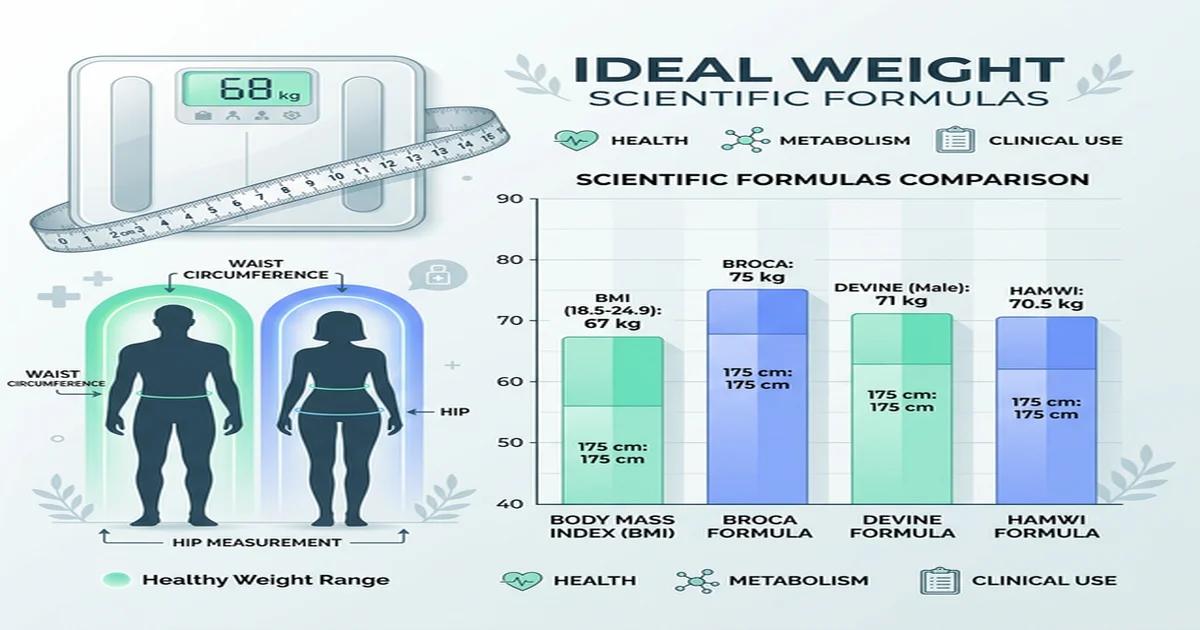
For a 175 cm tall man, the four formulas return values ranging from roughly 69 kg (Miller and Robinson) to 72 kg (Hamwi). For a 165 cm tall woman, the spread runs from about 56 kg (Hamwi) to 60 kg (Miller). These gaps are clinically significant when used for drug dosing or nutrition planning.
Which method is best for you?
No single formula wins in all scenarios. Here is a practical decision guide:
- If you need a quick clinical benchmark, Devine remains the industry default — most drug-dosing references still use it.
- If you are a woman and find Devine too low, Robinson or Miller may feel more realistic because they start from a higher base.
- If you prefer a range rather than a point estimate, the WHO BMI approach offers the widest and most inclusive window.
- If you want the fullest picture, compare all five methods side by side. Our ideal weight calculator does exactly that in one step.
Limitations you should know
Muscle mass is invisible
A strength athlete may weigh 15 kg more than any formula suggests and still carry a perfectly healthy body-fat percentage. IBW equations treat every kilogram the same, whether it is bone, muscle, fat or water.
Frame size is ignored
People with naturally broad shoulders and thick wrists have heavier skeletal frames. Some clinicians apply a ±10 % adjustment for small and large frames, but the formulas themselves make no such correction.
Age and ethnicity are absent
All four equations were derived primarily from young-to-middle-aged White American or European populations. Optimal BMI thresholds differ for East Asian, South Asian and Pacific Islander populations, and healthy weight naturally shifts with age as lean mass declines and fat distribution changes.
Important disclaimer
IBW formulas are screening tools, not diagnoses. Always combine them with clinical measures like waist circumference, body-fat percentage and blood markers before making dietary or medical decisions.
Waist-to-height ratio is emerging as a complementary metric that outperforms BMI alone for predicting cardiovascular risk. A ratio above 0.5 flags visceral fat accumulation regardless of total weight. If your IBW result seems off, this simple measurement can provide valuable additional context.
Compare all methods at once
Manually running five formulas is tedious. Our ideal weight calculator lets you enter your height and sex, then instantly shows the Devine, Robinson, Miller and Hamwi results alongside the full WHO BMI healthy range. You can see at a glance where the formulas agree and where they diverge.
Use the comparison as a starting point for a conversation with your doctor or dietitian — not as a final verdict. Health is multidimensional, and no single number, however scientifically derived, can capture the whole picture.
Understanding the origins, mechanics and blind spots of each formula puts you in a stronger position to interpret your results. Whether you lean on Devine for its clinical pedigree, Robinson for its updated data, or simply use the WHO range for flexibility, the key takeaway is the same: ideal weight is a reference zone, not a fixed destination.
Sources
- Devine BJ. Gentamicin therapy. Drug Intell Clin Pharm. 1974;8:650–655.
- Robinson JD et al. Determination of ideal body weight for drug dosage calculations. Am J Hosp Pharm. 1983;40(6):1016–1019.
- WHO. Obesity and overweight fact sheet. 2024.
- Peterson CM et al. Universal equation for estimating ideal body weight and body weight at any BMI. Am J Clin Nutr. 2016;103(5):1197–1203.
- Pai MP, Paloucek FP. The origin of the "ideal" body weight equations. Ann Pharmacother. 2000;34(9):1066–1069.