
BAC Calculator — Blood Alcohol Content Estimator
Can you drive? Estimate your BAC (g/dL and ‰), compare it with the legal limit in your country (US, UK, Scotland, Canada, Ireland, Australia, NZ, South Africa) and see the time from which you would be under it.
1 standard drink = 12 oz beer / 5 oz wine / 1.5 oz spirit (all ≈ 14g alcohol)
Enter 0 if you are estimating peak BAC
CalcVita. (2026). BAC Calculator — Blood Alcohol Content Estimator. CalcVita. Retrieved October 17, 2026, from https://calcvita.com/en/calculators/bac
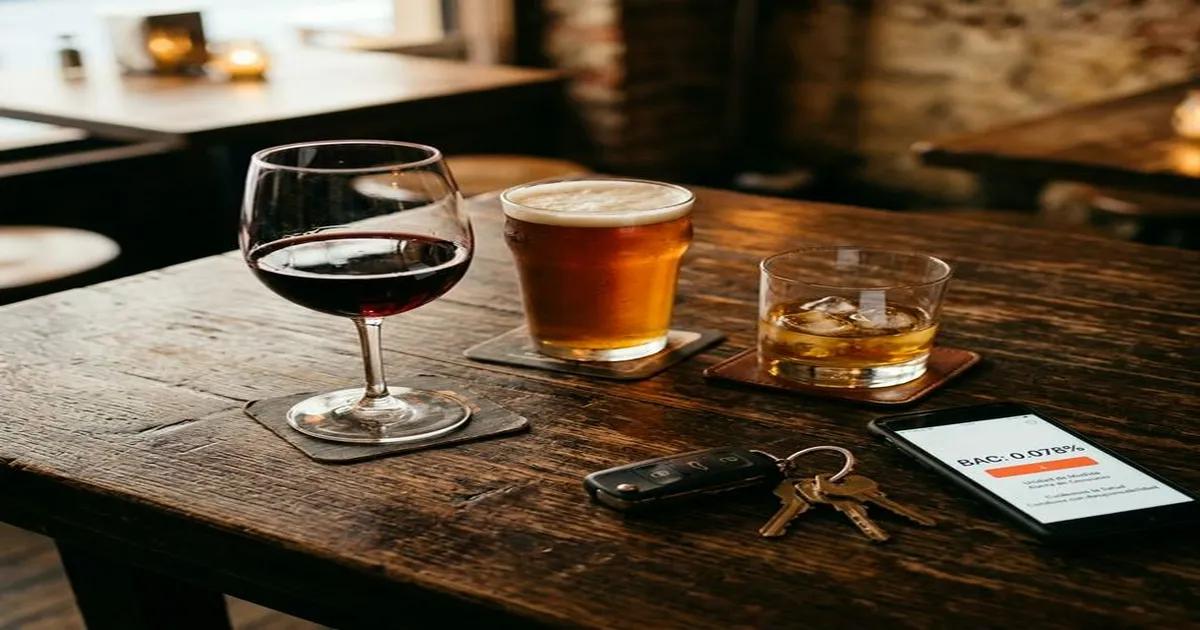
Suggested article
Blood Alcohol Content (BAC): How It's Calculated and What It Means
Learn how blood alcohol content is measured, how the Widmark formula works, and what different BAC levels mean for your body and your safety on the road.
Read the full article →How does the BAC calculator work?
Enter your body weight, sex, drink type, number of drinks, and hours since you started drinking. The calculator applies the Widmark formula — the standard forensic toxicology method since 1932 — to estimate your current BAC, the time until you reach 0.00 g/dL, and how your BAC compares to legal driving limits in different countries.
The Widmark formula explained
BAC (g/dL) = (alcohol_grams × 100) / (r × body_weight_grams) − β × hours. The Widmark r-factor (0.68 for men, 0.55 for women) reflects the share of body weight into which alcohol distributes — essentially body water, not fat. β (0.015 g/dL/hr) is the average liver metabolism rate. A US standard drink = 14g pure alcohol (12 oz beer / 5 oz wine / 1.5 oz spirit, all ~5-12-40% ABV respectively).
Global legal limits
The table below lists the threshold at which each country penalises drink-driving, with a link to its statute. Elsewhere: 0.0 g/L in the Czech Republic, Hungary and much of Latin America; 0.2 g/L in Sweden, Norway and Poland; 0.5 g/L in most of the EU; 0.8 g/L in the United States, England and Canada.
Legal drink-drive limits by country (g/L of blood)
Threshold at which the law penalises, in grams of alcohol per litre of blood (0.5 g/L = 0.05 g/dL = 50 mg/100 mL). Breath equivalents follow each country’s statutory ratio. Every figure links to the law it comes from.
| Country | General | Other drivers | Source |
|---|---|---|---|
| United States | 0,8 g/L | — | 23 U.S.C. § 163 (0.08 per se; adopted by every state), § 163 |
| United Kingdom (England, Wales, N. Ireland) | 0,8 g/L | — | Road Traffic Act 1988 (GOV.UK drink-drive limit), s. 11 |
| Scotland | 0,5 g/L | — | Road Traffic Act 1988 as amended for Scotland (GOV.UK drink-drive limit), s. 11 |
| Canada | 0,8 g/L | — | Criminal Code of Canada, s. 320.14(1)(b) |
| Ireland | 0,5 g/L | Learner / novice (or under 20-21): 0,2 g/L · Professional / commercial / passenger transport: 0,2 g/L | Road Traffic Act 2010, s. 4 |
| Australia | 0,5 g/L | Learner / novice (or under 20-21): 0,0 g/L · Professional / commercial / passenger transport: 0,0 g/L | State road rules (Queensland Government, StreetSmarts), Transport Operations (Road Use Management) Act 1995 s. 79 |
| New Zealand | 0,5 g/L | Learner / novice (or under 20-21): 0,0 g/L | Land Transport Act 1998 (Ministry of Transport), ss. 56-57A |
| South Africa | 0,5 g/L | Professional / commercial / passenger transport: 0,2 g/L | National Road Traffic Act 93 of 1996, s. 65 |
- United States: Every state applies a 0.08 g/dL per se limit (Utah: 0.05). Commercial drivers: 0.04 (49 CFR 382.201). Drivers under 21: 0.02 in every state (23 U.S.C. § 161).
- United Kingdom (England, Wales, N. Ireland): England, Wales and Northern Ireland: 80 mg per 100 mL of blood, 35 µg per 100 mL of breath. Scotland is stricter: select it separately.
- Scotland: Scotland: 50 mg per 100 mL of blood, 22 µg per 100 mL of breath since December 2014.
- Canada: Criminal offence at 80 mg per 100 mL within two hours of driving. Provinces add administrative sanctions at lower levels (commonly 0.05) and zero tolerance for new drivers.
- Ireland: "Specified persons" — learner permit holders, holders of a first driving licence and drivers of buses, taxis, HGVs and other categories listed in s. 3 — are limited to 20 mg per 100 mL.
- Australia: Limits are set by each state, with the same pattern nationwide: under 0.05 for open/full licences, zero for learner, provisional and probationary drivers and for heavy-vehicle, bus and taxi drivers.
- New Zealand: Drivers under 20: zero. 50-80 mg per 100 mL (250-400 µg per litre of breath): infringement fine and demerit points; above 80 mg: criminal offence.
- South Africa: 0.05 g per 100 mL of blood (0.24 mg per litre of breath) in general; 0.02 g per 100 mL (0.10 mg per litre of breath) for professional drivers (section 32).
Legal texts checked on 22 September 2026.
Factors that affect BAC
Several factors influence your BAC beyond weight and gender: food in your stomach (slows alcohol absorption and lowers the peak), carbonated mixers (speed absorption), fatigue (increases impairment for same BAC), medications (may amplify effects), and tolerance (affects perceived impairment but NOT actual BAC). The liver can only process ~one standard drink per hour regardless of other factors.
Scientific References
- Widmark EMP (1932). Die theoretischen Grundlagen und die praktische Verwendbarkeit der gerichtlich-medizinischen Alkoholbestimmung. Urban & Schwarzenberg, Berlin.
- Posey DL, Mozayani A (2007). The estimation of blood alcohol concentration: Widmark revisited. Forensic Science, Medicine, and Pathology 3(1):33–39. PMID 25868887
- Dubowski KM (1985). Absorption, distribution and elimination of alcohol: highway safety aspects. Journal of Studies on Alcohol Suppl 10:98–108. PMID 3862865
- NIAAA. What Is a Standard Drink? National Institute on Alcohol Abuse and Alcoholism, NIH.
- How does the BAC calculator work?
- This calculator uses the Widmark formula, the gold standard in forensic toxicology since 1932. BAC (g/dL) = (alcohol_grams × 100) / (r × body_weight_grams) − 0.015 × hours. Where r is the Widmark distribution factor (0.68 for men, 0.55 for women) and 0.015 g/dL/hour is the average alcohol metabolism rate. A US standard drink contains approximately 14g of pure alcohol.
- What is BAC and why does it matter?
- Blood Alcohol Content (BAC) measures the concentration of alcohol in your blood, expressed in grams per deciliter (g/dL). At 0.08 g/dL — the legal driving limit in the US and in England, Wales and Northern Ireland — most people show impaired judgment, reaction time, and coordination. Even at 0.05 g/dL (the limit in most of the EU, Scotland and Australia), driving ability is measurably reduced. At 0.30+ g/dL, loss of consciousness and medical emergency can occur.
- Why do men and women have different BAC levels for the same drinks?
- The Widmark r-factor reflects how much of the body alcohol can spread into, which is essentially body water. Men average r = 0.68 and women r = 0.55 because women generally have a higher proportion of body fat, which does not absorb alcohol. This means women reach higher BAC levels than men of the same weight drinking the same amount.
- How long does it take to sober up?
- The liver metabolizes alcohol at approximately 0.015 g/dL per hour on average — equivalent to about one standard drink per hour. This rate is relatively constant and is NOT significantly affected by coffee, water, food, exercise, or cold showers. Time to sober up = current BAC ÷ 0.015. For example, a BAC of 0.09 g/dL takes 0.09 ÷ 0.015 = 6 hours to reach 0.00.
- What is the legal drink-drive limit in my country?
- In grams of alcohol per litre of blood: United States 0.8 (0.08 g/dL; Utah 0.05, commercial drivers 0.04), England, Wales and Northern Ireland 0.8 (80 mg/100 mL), Scotland 0.5, Canada 0.8 (provinces sanction from 0.05), Ireland 0.5 (0.2 for learners, first two years and professional drivers), Australia 0.5 (zero for learner, provisional and heavy-vehicle drivers), New Zealand 0.5 (zero under 20) and South Africa 0.5 (0.2 professional). The calculator applies the limit of the country and driver profile you select and links each figure to its statute.
- Is the BAC calculator accurate for driving decisions?
- No. This calculator provides a scientific estimate, but individual results vary significantly based on medication use, food intake, fatigue, tolerance, health conditions, and exact body composition. The only reliable way to know your BAC is a certified breathalyzer or blood test. Never use this calculator to decide whether it is safe to drive — if you have had any alcohol, use a sober driver, rideshare, or public transport.
More calculators
Keep exploring helpful tools
BMI calculator
Compute your BMI with WHO ranges and guidance.
Ideal weight calculator
Calculate ideal weight using 4 scientific formulas + WHO range.
Body fat calculator
Estimate body fat % using US Navy or CUN-BAE methods.
Water intake calculator
Calculate daily water needs based on weight and activity.